Yolo Text

Information

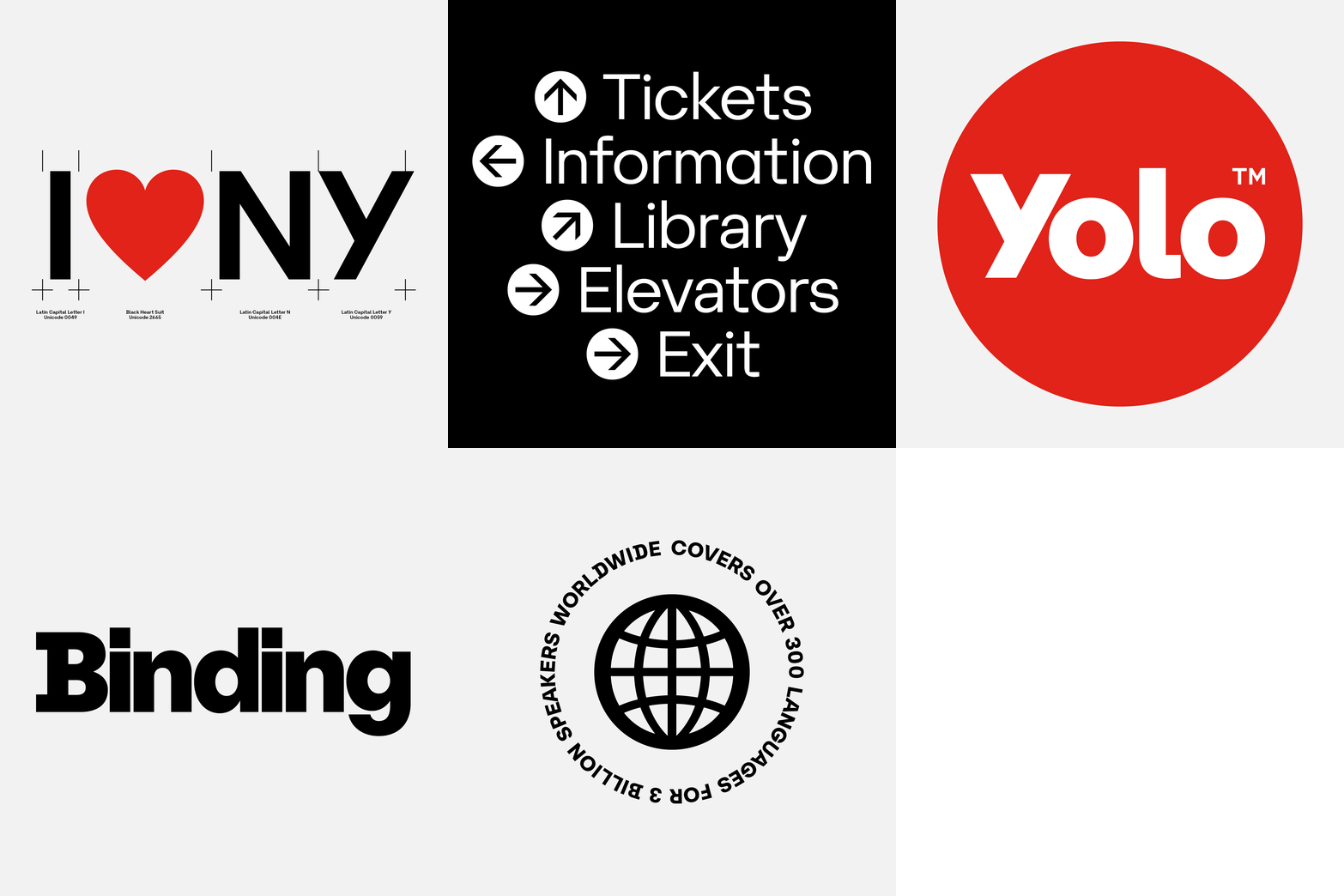
Yolo is a set of strictly geometric typefaces based on a fundamental circular, square, and rectangular base. Using a monolinear stroke in character construction, it combines refracted right angles and precise curves and ends all open shapes strictly horizontal or vertical. This gives the typeface a technicist to the industrial character.


Read more in the editorial
  • Number of fonts in a family: 10
  • Release date: 2025
  • Current version: 1.001
  • Available formats: OTF, TTF, WOFF, WOFF2
  • Variable file: Available upon request with the purchase of the complete type family.
  • Design: Tomáš Brousil
160 languages
  • Abaza
  • Adyghe
  • Afar
  • Afrikaans
  • Aghul
  • Albanian
  • Aromanian
  • Avar
  • Aymara
  • Azeri (Cyrillic)
  • Balkar
  • Basque
  • Belarusian
  • Bemba
  • Bislama
  • Bosnian
  • Breton
  • Bulgarian
  • Buryat
  • Catalan
  • Chamorro
  • Chechen
  • Cheyenne
  • Chichewa
  • Chinese (Mandarin)
  • Chuukese
  • Cofán
  • Cornish
  • Crimean Tatar
  • Croatian
  • Czech
  • Danish
  • Dargin
  • Dungan
  • Dutch
  • English
  • Esperanto
  • Estonian
  • Faroese
  • Fijian
  • Finnish
  • French
  • Frisian
  • Friulian
  • Gagauz
  • Galician
  • Ganda
  • German
  • Gikuyu
  • Greek
  • Greenlandic
  • Guaraní
  • Gwich’in
  • Haitian
  • Hawaiian
  • Hungarian
  • Icelandic
  • Ido
  • Indonesian
  • Ingush
  • Interlingua
  • Irish Gaelic
  • Italian
  • Javanese
  • Kabardian
  • Kalmyk
  • Karakalpak
  • Kashubian
  • Kazakh
  • Kinyarwanda
  • Kirghyz
  • Kiribati
  • Kirundi
  • Kituba
  • Komi
  • Kumyk
  • Kurdish (Latin)
  • Ladin
  • Latvian
  • Lezgian
  • Lithuanian
  • Luxemburgish
  • Macedonian
  • Malagasy
  • Malay
  • Maltese
  • Manci
  • Manx
  • Māori
  • Mari
  • Marshallese
  • Moldovan
  • Mongolian
  • Montenegrin
  • Mordvin (Erzya)
  • Mordvin (Moksha)
  • Náhuatl
  • Nanai
  • Nauruan
  • Navajo
  • Ndebele (Northern)
  • Ndebele (Southern)
  • Nogai
  • Norfuk
  • Norn
  • Norwegian (Bokmål)
  • Occitan
  • Palauan
  • Papiamento
  • Polish
  • Portuguese
  • Quechua
  • Rhaeto-Romanic
  • Romaji
  • Romanian
  • Russian
  • Rutul
  • Sámi (Inari)
  • Sámi (Lule)
  • Sámi (Northern)
  • Sámi (Southern)
  • Samoan
  • Sango
  • Sardinian
  • Scottish Gaelic
  • Seychelles Creole
  • Shona
  • Silesian
  • Slovak
  • Slovene
  • Somali (Latin)
  • Sotho
  • Spanish
  • Swahili
  • Swati
  • Swedish
  • Tabasaran
  • Tagalog (Filipino)
  • Tahitian
  • Tajik
  • Tatar
  • Tetum
  • Tok Pisin
  • Tokelauan
  • Tongan
  • Tsonga
  • Tswana
  • Turkish
  • Turkmen
  • Tuva
  • Tuvalu
  • Udmurt
  • Uighur
  • Ukrainian
  • Uzbek
  • Veps
  • Welsh
  • Wolof
  • Xhosa
  • Zulu

Styles

Light 
Light Italic 
Regular 
Italic 
Medium 
Medium Italic 
Semibold 
Semibold Italic 
Bold 
Bold Italic

Specimen

Yolo Text Light

from 75 EUR

Upstream

Yolo Text Light Italic

from 75 EUR

Splashing

Yolo Text Regular

from 75 EUR

Celestina

Yolo Text Italic

from 75 EUR

Binational

Yolo Text Medium

from 75 EUR

Kleptistic

Yolo Text Medium Italic

from 75 EUR

Escapism

Yolo Text Semibold

from 75 EUR

Adhesion

Yolo Text Semibold Italic

from 75 EUR

Repletely

Yolo Text Bold

from 75 EUR

Inspiriter

Yolo Text Bold Italic

from 75 EUR

Magnetic

Yolo Text Bold

from 75 EUR

Summer, or summertime, is the warmest and brightest of the four temperate seasons, occurring between spring and autumn. Around the time of the summer solstice, daylight reaches its maximum length while nighttime is shortest, after which days gradually become shorter.

Yolo Text Bold Italic

from 75 EUR

The earliest sunrises and latest sunsets occur near the solstice, although the exact start of summer varies depending on cultural, climatic, or scientific definitions. When it is summer in the Northern Hemisphere, the Southern Hemisphere experiences winter, and vice versa.

Yolo Text Regular

from 75 EUR

According to meteorological convention, summer consists of June, July, and August in the Northern Hemisphere and December, January, and February in the Southern Hemisphere. This system divides the year into seasons based on temperature patterns and aligns summer with the period of the longest and warmest days. Many countries, including Australia, New Zealand, and Japan, use this definition, and it is also widely applied in regions such as the United Kingdom and Canada. Although daylight increases from the spring equinox to the solstice, the solstice itself represents the midpoint of summer when considering daylight alone, not its beginning. Due to seasonal lag, the warmest period typically occurs several weeks after the point of maximum solar radiation. Historically, different calendars placed the start and duration of summer differently. In ancient Roman and Anglo-Saxon traditions, summer began in early May and reached its midpoint around the summer solstice in late June. Across Europe, the solstice was often celebrated as midsummer, and festivals around this time marked an important seasonal transition. Cultural traditions have also shaped how summer is defined. In parts of Europe, it was traditionally considered to begin around early May, while in Celtic regions it was marked by seasonal festivals. In North America, summer is often associated with the period between late May and early September, corresponding to major public holidays and school breaks. In the Southern Hemisphere, particularly in countries like Australia and Brazil, summer coincides with the Christmas and New Year holiday period, when many people take extended vacations. In some regions, seasonal definitions are based on astronomical or traditional calendars. For example, in Chinese seasonal reckoning, summer always starts at the beginning of May and ends at the beginning of August.

Yolo Text Regular

from 75 EUR

A season is a division of the year based on recurring changes in weather, ecological conditions, and the length of daylight in a particular region. These seasonal patterns on Earth are primarily caused by the tilt of the planet’s axis as it orbits the Sun. In temperate and polar areas, seasons are marked by variations in sunlight intensity, which influence temperature changes, plant growth cycles, and animal behavior such as migration or hibernation. Different cultures define seasons in various ways depending on local climate conditions, resulting in multiple systems of classification across the world. The Northern Hemisphere receives the most direct sunlight during late spring and summer, roughly from May to July, while the Southern Hemisphere experiences this peak between November and January. The tilt of the Earth causes the Sun to appear higher in the sky during summer months, increasing the amount of solar energy received. Due to a delay in how the Earth absorbs and releases heat, the warmest months usually occur slightly after the peak sunlight period. In many temperate regions, four seasons are commonly recognized: spring, summer, autumn, and winter. However, ecologists sometimes divide the year into six phases based on biological changes, while tropical regions often distinguish only between wet and dry seasons, with occasional additional transitional periods. Seasons can also be defined by significant environmental events, such as hurricane or wildfire seasons. Historically, some civilizations based their seasonal systems on natural cycles specific to their environment. For example, ancient Egypt identified seasons according to the flooding patterns of the Nile. In agricultural societies, seasonal changes are especially important, as they determine planting and harvesting times and are often associated with cultural rituals and traditions. In India, a traditional system recognizes six distinct seasons aligned with cultural and agricultural practices. Astronomical definitions of seasons are based on the Earth’s position relative to the Sun. In this system, seasons begin at key points such as the equinoxes and solstices. This method has roots in ancient calendars, including those used by the Romans. Because Earth’s orbit is slightly elliptical, the lengths of the seasons are not equal, with small variations in the time between these astronomical events. Today, astronomical timing is widely used to define the start of seasons, although some countries prefer meteorological definitions based on temperature patterns. The dates of the equinoxes and solstices do not remain fixed within the modern Gregorian calendar.

Yolo Text Regular

from 75 EUR

Сезон — это деление года, основанное на повторяющихся изменениях погоды, экологических условий и продолжительности светового дня в определённом регионе. Эти сезонные закономерности на Земле в основном вызваны наклоном оси планеты во время её обращения вокруг Солнца. В умеренных и полярных областях сезоны характеризуются изменениями интенсивности солнечного света, что влияет на колебания температуры, циклы роста растений и поведение животных, например миграцию или спячку. Разные культуры определяют сезоны по-разному в зависимости от местных климатических условий, поэтому в мире существует несколько систем их классификации. Северное полушарие получает наибольшее количество прямого солнечного света в конце весны и летом, примерно с мая по июль, тогда как в Южном полушарии этот пик приходится на период с ноября по январь. Из-за наклона Земли Солнце летом поднимается выше над горизонтом, что увеличивает количество получаемой солнечной энергии. Из-за задержки в поглощении и отдаче тепла Землёй самые тёплые месяцы обычно наступают немного позже периода максимальной освещённости. Во многих умеренных регионах обычно выделяют четыре сезона: весну, лето, осень и зиму. Однако экологи иногда делят год на шесть фаз на основе биологических изменений, тогда как в тропических регионах часто различают только влажный и сухой сезоны, иногда с дополнительными переходными периодами. Сезоны также могут определяться значительными природными явлениями, такими как сезоны ураганов или лесных пожаров. Исторически некоторые цивилизации основывали свои системы сезонов на природных циклах, характерных для их среды. Например, в древнем Египте сезоны определялись по разливам Нила. В сельскохозяйственных обществах сезонные изменения имеют особое значение, поскольку они определяют сроки посева и сбора урожая и часто связаны с культурными ритуалами и традициями. В Индии существует традиционная система, выделяющая шесть сезонов, согласованных с культурными и сельскохозяйственными практиками. Астрономические определения сезонов основаны на положении Земли относительно Солнца. В этой системе сезоны начинаются в ключевые моменты, такие как равноденствия и солнцестояния. Этот метод уходит корнями в древние календари, включая римские.

Yolo Text Regular

from 75 EUR

Η εποχή είναι μια διαίρεση του έτους που βασίζεται σε επαναλαμβανόμενες αλλαγές στον καιρό, στις οικολογικές συνθήκες και στη διάρκεια του φωτός της ημέρας σε μια συγκεκριμένη περιοχή. Αυτά τα εποχικά πρότυπα στη Γη προκαλούνται κυρίως από την κλίση του άξονα του πλανήτη καθώς αυτός περιφέρεται γύρω από τον Ήλιο. Στις εύκρατες και πολικές περιοχές, οι εποχές χαρακτηρίζονται από μεταβολές στην ένταση του ηλιακού φωτός, οι οποίες επηρεάζουν τις αλλαγές της θερμοκρασίας, τους κύκλους ανάπτυξης των φυτών και τη συμπεριφορά των ζώων, όπως η μετανάστευση ή η χειμερία νάρκη. Διαφορετικοί πολιτισμοί ορίζουν τις εποχές με ποικίλους τρόπους, ανάλογα με τις τοπικές κλιματικές συνθήκες, γεγονός που οδηγεί σε πολλαπλά συστήματα ταξινόμησης σε όλο τον κόσμο. Το Βόρειο Ημισφαίριο δέχεται το πιο άμεσο ηλιακό φως κατά τα τέλη της άνοιξης και το καλοκαίρι, περίπου από τον Μάιο έως τον Ιούλιο, ενώ το Νότιο Ημισφαίριο βιώνει αυτή την κορύφωση μεταξύ Νοεμβρίου και Ιανουαρίου. Η κλίση της Γης προκαλεί την εμφάνιση του Ήλιου ψηλότερα στον ουρανό κατά τους θερινούς μήνες, αυξάνοντας την ποσότητα της ηλιακής ενέργειας που λαμβάνεται. Λόγω καθυστέρησης στον τρόπο με τον οποίο η Γη απορροφά και αποδίδει θερμότητα, οι θερμότεροι μήνες εμφανίζονται συνήθως λίγο μετά την περίοδο μέγιστης ηλιακής ακτινοβολίας. Σε πολλές εύκρατες περιοχές αναγνωρίζονται συνήθως τέσσερις εποχές: άνοιξη, καλοκαίρι, φθινόπωρο και χειμώνας. Ωστόσο, οι οικολόγοι μερικές φορές χωρίζουν το έτος σε έξι φάσεις βάσει βιολογικών αλλαγών, ενώ οι τροπικές περιοχές συχνά διακρίνουν μόνο μεταξύ υγρής και ξηρής περιόδου, με περιστασιακές μεταβατικές φάσεις. Οι εποχές μπορούν επίσης να οριστούν βάσει σημαντικών περιβαλλοντικών γεγονότων, όπως οι περίοδοι τυφώνων ή δασικών πυρκαγιών. Ιστορικά, ορισμένοι πολιτισμοί βασίζονταν σε φυσικούς κύκλους που ήταν συγκεκριμένοι για το περιβάλλον τους. Για παράδειγμα, η αρχαία Αίγυπτος όριζε τις εποχές σύμφωνα με τα μοτίβα πλημμύρας του Νείλου. Στις αγροτικές κοινωνίες, οι εποχικές αλλαγές είναι ιδιαίτερα σημαντικές, καθώς καθορίζουν τις περιόδους σποράς και συγκομιδής και συχνά συνδέονται με πολιτιστικές τελετουργίες και παραδόσεις. Στην Ινδία, ένα παραδοσιακό σύστημα αναγνωρίζει έξι διακριτές εποχές, ευθυγραμμισμένες με πολιτιστικές και αγροτικές πρακτικές. Οι αστρονομικοί ορισμοί των εποχών βασίζονται στη θέση της Γης σε σχέση με τον Ηλιο.

OpenType features

Älternation?

Glyphs