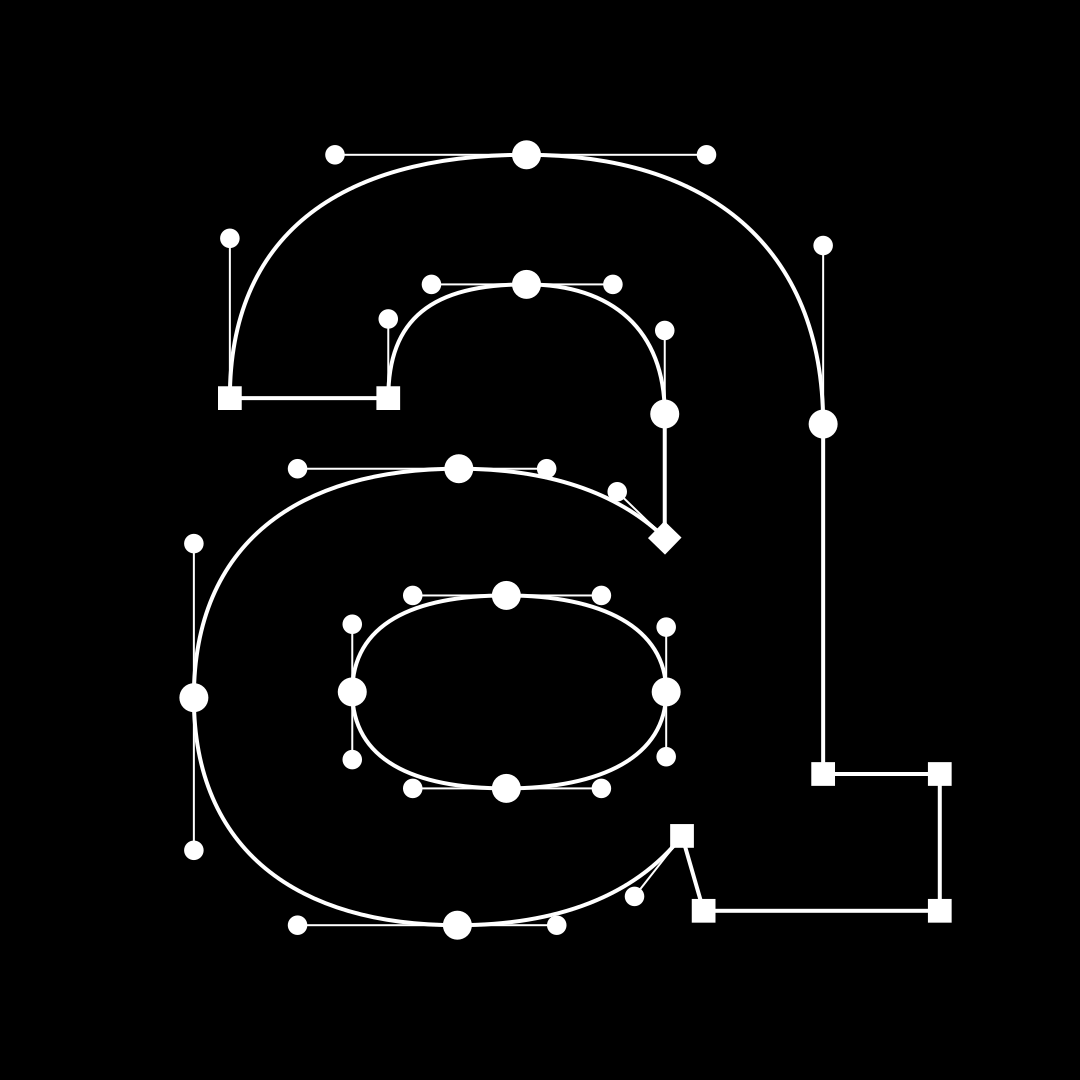
Kulturista

Information

A strong linear slab serif typeface with distinctive rectangular serifs. The characteristic glyph proportions, weight range, and character set are based on the sans-serif typeface Nudista, and Kulturista is its ideal pairing partner. The italic has the same width and color scheme as the basic styles, but it is not merely a mechanically slanted version of the upright, as is often the case with typefaces derived from geometric shapes. Several characters have unique variants, which significantly enhance their ability to stand out in a typeset.

  • Number of fonts in a family: 12
  • Release date: 2009
  • Current version: 1.001
  • Available formats: OTF, TTF, WOFF, WOFF2
  • Design: Tomáš Brousil
117 languages
  • Afar
  • Afrikaans
  • Albanian
  • Aromanian
  • Aymara
  • Azeri (Latin)
  • Basque
  • Bemba
  • Bislama
  • Bosnian
  • Breton
  • Catalan
  • Chamorro
  • Cheyenne
  • Chichewa
  • Chuukese
  • Cofán
  • Cornish
  • Croatian
  • Czech
  • Danish
  • Dutch
  • English
  • Esperanto
  • Estonian
  • Faroese
  • Fijian
  • Finnish
  • French
  • Frisian
  • Friulian
  • Galician
  • Ganda
  • German
  • Gikuyu
  • Greenlandic
  • Guaraní
  • Gwich’in
  • Haitian
  • Hawaiian
  • Hungarian
  • Icelandic
  • Ido
  • Indonesian
  • Interlingua
  • Irish Gaelic
  • Italian
  • Javanese
  • Kashubian
  • Kinyarwanda
  • Kiribati
  • Kirundi
  • Kituba
  • Kurdish (Latin)
  • Ladin
  • Latvian
  • Lithuanian
  • Luxemburgish
  • Malagasy
  • Malay
  • Maltese
  • Manx
  • Māori
  • Marshallese
  • Montenegrin
  • Náhuatl
  • Nauruan
  • Navajo
  • Ndebele (Northern)
  • Ndebele (Southern)
  • Norfuk
  • Norn
  • Norwegian (Bokmål)
  • Occitan
  • Palauan
  • Papiamento
  • Pinyin
  • Polish
  • Portuguese
  • Quechua
  • Rhaeto-Romanic
  • Romaji
  • Romanian
  • Sámi (Inari)
  • Sámi (Lule)
  • Sámi (Northern)
  • Sámi (Southern)
  • Samoan
  • Sango
  • Sardinian
  • Scottish Gaelic
  • Seychelles Creole
  • Shona
  • Silesian
  • Slovak
  • Slovene
  • Somali (Latin)
  • Sotho
  • Spanish
  • Swahili
  • Swati
  • Swedish
  • Tagalog (Filipino)
  • Tahitian
  • Tetum
  • Tok Pisin
  • Tokelauan
  • Tongan
  • Tsonga
  • Tswana
  • Turkish
  • Tuvalu
  • Veps
  • Welsh
  • Wolof
  • Xhosa
  • Zulu

Styles

Thin 
Thin Italic 
Light 
Light Italic 
Medium 
Medium Italic 
SemiBold 
SemiBold Italic 
Bold 
Bold Italic 
Black 
Black Italic

Specimen

Kulturista Thin

from 39 EUR

Remake

Kulturista Thin Italic

from 39 EUR

Afterfall

Kulturista Light

from 39 EUR

Heather

Kulturista Light Italic

from 39 EUR

Without

Kulturista Medium

from 39 EUR

Numero

Kulturista Medium Italic

from 39 EUR

Firewall

Kulturista SemiBold

from 39 EUR

Eclipsis

Kulturista SemiBold Italic

from 39 EUR

Sadistic

Kulturista Bold

from 39 EUR

Octopus

Kulturista Bold Italic

from 39 EUR

Restake

Kulturista Black

from 39 EUR

Autumn

Kulturista Black Italic

from 39 EUR

Minibus

Kulturista SemiBold

from 39 EUR

Bodybuilding developed during the late nineteenth century and became especially popular in England through the influence of the German athlete Eugen Sandow. Often described as the “father of modern bodybuilding,” Sandow organised performances that focused on displaying his muscular physique before large audiences. These exhibitions introduced the idea of “muscle display performances,” in which the visual appearance of the body became the central attraction for spectators.

Kulturista SemiBold Italic

from 39 EUR

At the time, audiences were fascinated by impressive physical development, although these performances still retained connections to older demonstrations of strength, wrestling contests, and circus-style exhibitions. With the support of his manager Florenz Ziegfeld, Sandow gradually transformed such shows into theatrical events centred almost entirely on the presentation and admiration of the muscular human body on stage.

Kulturista SemiBold

from 39 EUR

In competitive bodybuilding, participants aim to present a physique that is considered aesthetically balanced and visually appealing. During the prejudging phase, competitors perform a set of compulsory poses, including the front lat spread, rear lat spread, front double biceps, back double biceps, side chest, side triceps, the Most Muscular pose (performed only by men), as well as abdominals and thighs. Each competitor also presents an individual choreographed routine designed to highlight their physical development. At the end of the posing round, a posedown often takes place while judges complete their evaluations. Because posing plays an essential role in presentation, bodybuilders are encouraged to practise extensively, often using mirrors or working under the supervision of a coach. Unlike strongman or powerlifting competitions, where maximum strength is the primary objective, or Olympic weightlifting, which combines strength with technical precision, bodybuilding competitions focus mainly on physical condition, muscular size, proportion, and symmetry. Various organizations may place different emphasis on particular criteria and may offer multiple competitive categories reflecting these priorities and differing international standards for athletic presentation. In addition, some federations distinguish between amateur and professional divisions, while others introduce categories based on age, height, body weight, or specific aesthetic preferences intended to broaden participation and create fairer comparisons among athletes from different backgrounds and training traditions around the world.

OpenType features

Cardiovascular

Glyphs

Kulturista in use