


Information
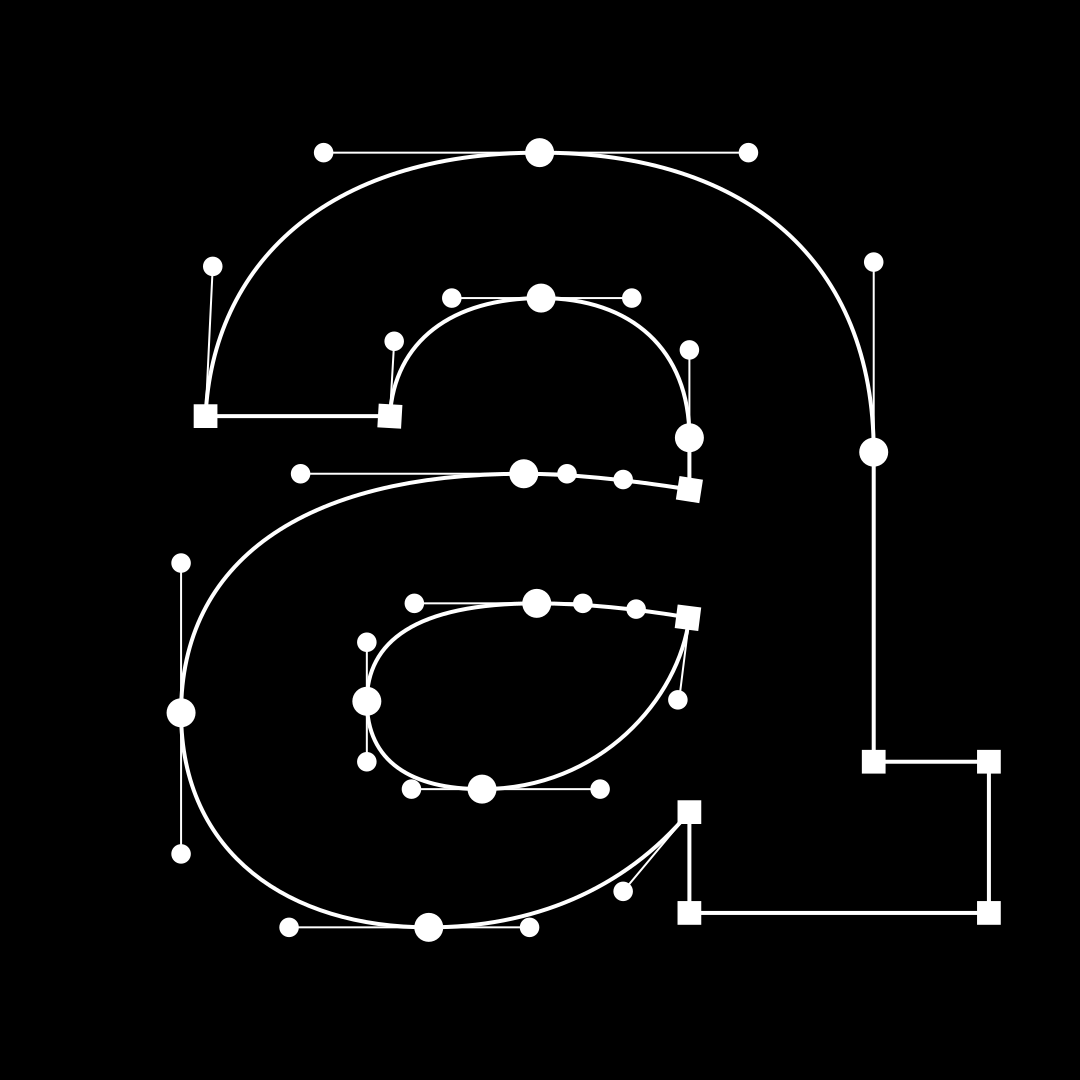
The sister pair of typefaces — the sans serif Pepi and the slab serif Rudi — is based on a playful engagement with the fundamental geometric shapes of the circle, square, and triangle, elements that formed the foundation of early typographic modernism.
The simple, Bauhaus-inspired functional typefaces of Herbert Bayer and Paul Renner established an entirely new trend at the beginning of the twentieth century. Typefaces derived from the circle achieved success through their novelty, objectivity, and fresh formal qualities. When Rudolf Wolf’s slab serif Memphis — often described as “Futura with serifs” — was later released, it effectively created a new stylistic school suited to the emerging needs of modern design, for which earlier typefaces appeared too ornamental, outdated, or obsolete.
Pepi and Rudi introduce certain contemporary features into this proven concept of constructed type. They create a regular rhythm by harmonizing character widths and increasing the x-height. An extreme range of ten weights, from Hair to Ultra, together with corresponding slanted styles, supports versatile use across the full spectrum of graphic design. Carefully designed diacritics, clear punctuation, tabular figures, ligatures, arrows, and alternate lowercase forms represent a standard that will satisfy anyone who needs to work efficiently with a neutral geometric display typeface.
- Number of fonts in a family: 20
- Release date: 2017
- Current version: 1.002
- Available formats: OTF, TTF, WOFF, WOFF2
- Variable file: Available upon request with the purchase of the complete type family.
- Design: Tomáš Brousil
- Afar
- Afrikaans
- Albanian
- Aromanian
- Aymara
- Azeri (Latin)
- Basque
- Bemba
- Bislama
- Bosnian
- Breton
- Catalan
- Chamorro
- Cheyenne
- Chichewa
- Chuukese
- Cofán
- Cornish
- Croatian
- Czech
- Danish
- Dutch
- English
- Esperanto
- Estonian
- Faroese
- Fijian
- Finnish
- French
- Frisian
- Friulian
- Galician
- Ganda
- German
- Gikuyu
- Greenlandic
- Guaraní
- Gwich’in
- Haitian
- Hawaiian
- Hungarian
- Icelandic
- Ido
- Indonesian
- Interlingua
- Irish Gaelic
- Italian
- Javanese
- Kashubian
- Kinyarwanda
- Kiribati
- Kirundi
- Kituba
- Kurdish (Latin)
- Ladin
- Latvian
- Lithuanian
- Luxemburgish
- Malagasy
- Malay
- Maltese
- Manx
- Māori
- Marshallese
- Montenegrin
- Náhuatl
- Nauruan
- Navajo
- Ndebele (Northern)
- Ndebele (Southern)
- Norfuk
- Norn
- Norwegian (Bokmål)
- Occitan
- Palauan
- Papiamento
- Pinyin
- Polish
- Portuguese
- Quechua
- Rhaeto-Romanic
- Romaji
- Romanian
- Sámi (Inari)
- Sámi (Lule)
- Sámi (Northern)
- Sámi (Southern)
- Samoan
- Sango
- Sardinian
- Scottish Gaelic
- Seychelles Creole
- Shona
- Silesian
- Slovak
- Slovene
- Somali (Latin)
- Sotho
- Spanish
- Swahili
- Swati
- Swedish
- Tagalog (Filipino)
- Tahitian
- Tetum
- Tok Pisin
- Tokelauan
- Tongan
- Tsonga
- Tswana
- Turkish
- Tuvalu
- Veps
- Welsh
- Wolof
- Xhosa
- Zulu
Styles

Specimen
Rudi Hair
from 39 EUR
Rudi Hair Italic
from 39 EUR
Rudi Thin
from 39 EUR
Rudi Thin Italic
from 39 EUR
Rudi Light
from 39 EUR
Rudi Light Italic
from 39 EUR
Rudi Regular
from 39 EUR
Rudi Italic
from 39 EUR
Rudi Medium
from 39 EUR
Rudi Medium Italic
from 39 EUR
Rudi SemiBold
from 39 EUR
Rudi SemiBold Italic
from 39 EUR
Rudi Bold
from 39 EUR
Rudi Bold Italic
from 39 EUR
Rudi Heavy
from 39 EUR
Rudi Heavy Italic
from 39 EUR
Rudi Black
from 39 EUR
Rudi Black Italic
from 39 EUR
Rudi Ultra
from 39 EUR
Rudi Ultra Italic
from 39 EUR
Rudi SemiBold
from 39 EUR
Rudi SemiBold Italic
from 39 EUR
Rudi Medium
from 39 EUR
OpenType features
Fundamental