Tabac Glam

Information

The category of typefaces that combine principles of serif and sans-serif design is often referred to as linear serif or humanist sans-serif. A serifless antiqua has attracted well-deserved attention with its elegant appearance since the beginning of the twentieth century. Tabac Glam is such a typeface — a high-contrast display font.
A sans-serif typeface dominated by vertical strokes can rarely compete in readability with book types, whose lowercase and uppercase letters are firmly anchored to the baseline by means of bottom serifs. However, if all characters in the set are clearly differentiated, the design can do without this otherwise useful aid — especially when it contains numerous dynamic details that disrupt the mechanical alternation of light and dark strokes within the alphabet.
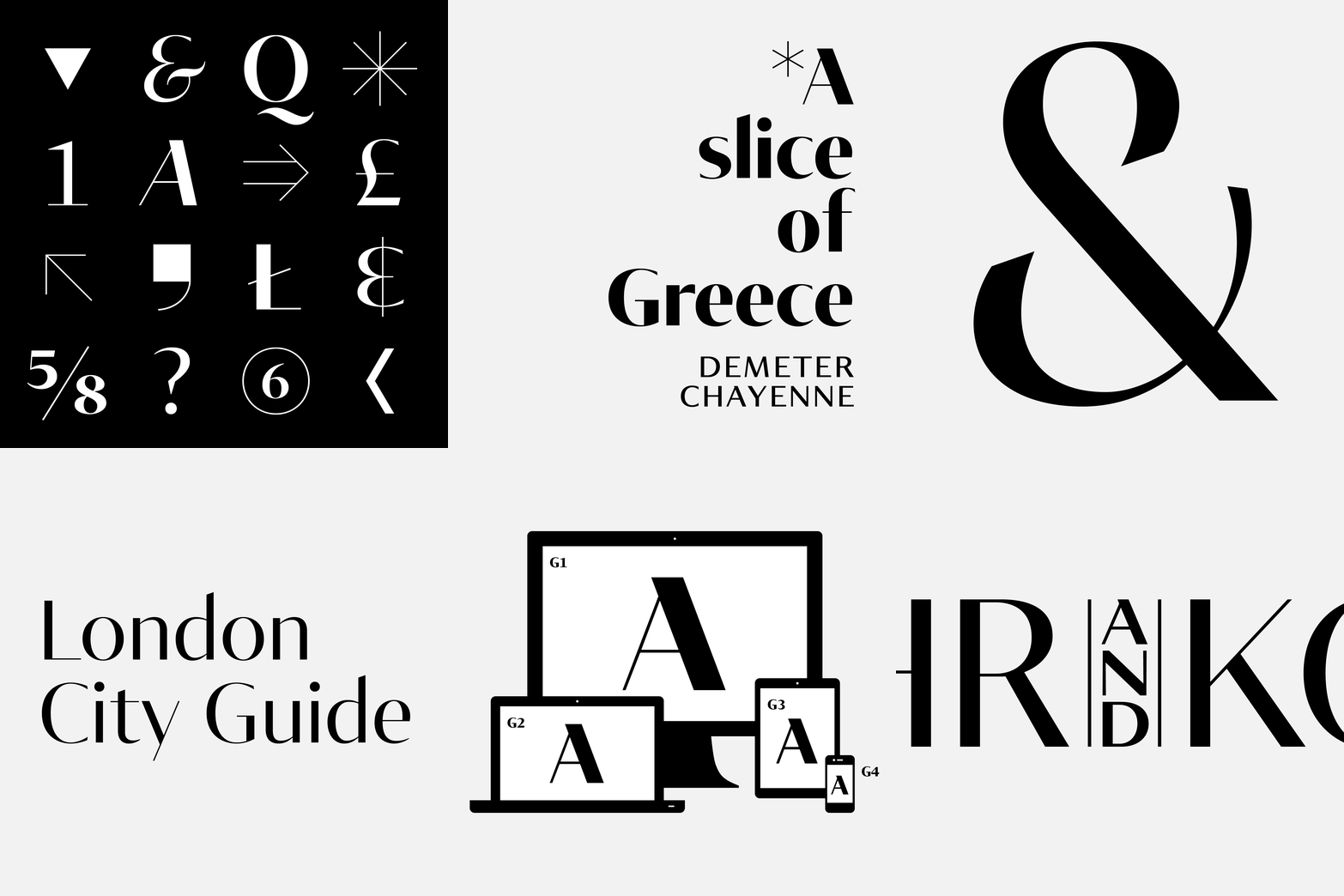
Like the serif branch of the Tabac family, Glam offers four degrees of secondary stroke contrast. Because Glam is designed primarily for display sizes, the differences between the individual grades are noticeably subtler. While G1 performs best in large headlines, G2 and G3 are suited to medium sizes, and G4 complements them effectively even in text settings, where excessive stroke contrast would complicate readability and threaten print consistency. Similarly, the contrast grades can be applied in digital responsive typography, where each level finds appropriate use across different screen sizes — desktop, laptop, tablet, and mobile.

Tabac Glam expands the expressive range of the Tabac superfamily with another distinctive tonal variation.

  • Number of fonts in a family: 0
  • Release date: 2016
  • Current version: 1.001
  • Available formats: OTF, TTF, WOFF, WOFF2
  • Design:
108 languages
  • Afar
  • Afrikaans
  • Albanian
  • Aromanian
  • Aymara
  • Basque
  • Bemba
  • Bislama
  • Bosnian
  • Breton
  • Catalan
  • Chamorro
  • Chichewa
  • Chuukese
  • Cofán
  • Croatian
  • Czech
  • Dutch
  • English
  • Esperanto
  • Estonian
  • Faroese
  • Fijian
  • Finnish
  • French
  • Frisian
  • Friulian
  • Galician
  • Ganda
  • German
  • Gikuyu
  • Greenlandic
  • Gwich’in
  • Haitian
  • Hawaiian
  • Hungarian
  • Icelandic
  • Ido
  • Indonesian
  • Interlingua
  • Irish Gaelic
  • Italian
  • Javanese
  • Kashubian
  • Kinyarwanda
  • Kiribati
  • Kirundi
  • Kituba
  • Kurdish (Latin)
  • Ladin
  • Latvian
  • Lithuanian
  • Luxemburgish
  • Malay
  • Maltese
  • Manx
  • Māori
  • Montenegrin
  • Náhuatl
  • Nauruan
  • Ndebele (Northern)
  • Ndebele (Southern)
  • Norfuk
  • Norn
  • Norwegian (Bokmål)
  • Occitan
  • Palauan
  • Papiamento
  • Polish
  • Portuguese
  • Quechua
  • Rhaeto-Romanic
  • Romaji
  • Romanian
  • Sámi (Inari)
  • Sámi (Lule)
  • Sámi (Northern)
  • Sámi (Southern)
  • Samoan
  • Sango
  • Sardinian
  • Scottish Gaelic
  • Seychelles Creole
  • Shona
  • Silesian
  • Slovak
  • Slovene
  • Somali (Latin)
  • Sotho
  • Spanish
  • Swahili
  • Swati
  • Swedish
  • Tagalog (Filipino)
  • Tahitian
  • Tetum
  • Tok Pisin
  • Tokelauan
  • Tongan
  • Tsonga
  • Tswana
  • Turkish
  • Tuvalu
  • Veps
  • Welsh
  • Wolof
  • Xhosa
  • Zulu

Styles

G1 Regular 
G1 Italic 
G1 Medium 
G1 Medium Italic 
G1 SemiBold 
G1 SemiBold Italic 
G1 Bold 
G1 Bold Italic
G2 Regular 
G2 Italic 
G2 Medium 
G2 Medium Italic 
G2 SemiBold 
G2 SemiBold Italic 
G2 Bold 
G2 Bold Italic
G3 Regular 
G3 Italic 
G3 Medium 
G3 Medium Italic 
G3 SemiBold 
G3 SemiBold Italic 
G3 Bold 
G3 Bold Italic
G4 Regular 
G4 Italic 
G4 Medium 
G4 Medium Italic 
G4 SemiBold 
G4 SemiBold Italic 
G4 Bold 
G4 Bold Italic

Specimen

Tabac Glam G1 Regular

from 59 EUR

Silverspot

Tabac Glam G1 Italic

from 59 EUR

Christmas

Tabac Glam G1 Medium

from 59 EUR

Orchestra

Tabac Glam G1 Medium Italic

from 59 EUR

Notebook

Tabac Glam G1 SemiBold

from 59 EUR

Autotoxic

Tabac Glam G1 SemiBold Italic

from 59 EUR

Romantic

Tabac Glam G1 Bold

from 59 EUR

Nailbrush

Tabac Glam G1 Bold Italic

from 59 EUR

Athletical

Tabac Glam G1 Bold

from 59 EUR

“Fashion journalists write about and critique fashion events and trends”

Tabac Glam G2 Regular

from 59 EUR

Fashion journalism began to take shape during the 18th century, when traditional fashion dolls used to present contemporary clothing styles were gradually replaced by printed fashion magazines.

Tabac Glam G2 Italic

from 59 EUR

In the 19th century, the number of fashion magazines increased significantly, and professional fashion journalists reported on current trends, especially those emerging from Paris.

Tabac Glam G1 Regular

from 59 EUR

Harper’s & Queen

Tabac Glam G3 Medium

from 59 EUR

Fashion illustration has existed for nearly five centuries. Since clothing has been created, there has also been a need to visually communicate ideas, designs, and stylistic concepts. Fashion illustrations not only depict garments but also function as an independent artistic form. Many illustrations were originally intended to be viewed at close range, requiring careful attention to detail and refined technical skill.

Tabac Glam G3 Medium Italic

from 59 EUR

During the late 1930s, the role of fashion illustration began to decline when magazines such as Vogue increasingly replaced illustrated covers with photographic images. This shift represented a significant turning point in the fashion industry, as photography gradually became the dominant visual medium for presenting clothing. Fashion illustration, once the primary means of communicating fashion ideas, began to occupy a more limited role.

Tabac Glam G4 Regular

from 59 EUR

Fashion illustration differs from the fashion plate, which is essentially a reproduction of an image intended for publication in magazines or books. Although illustrations may be reproduced as fashion plates, the plate itself does not represent an original creative work. In contemporary practice, fashion illustrations are often viewed as interpretative representations of garments rather than exact visual copies. Illustrators working independently generally have greater creative freedom, whereas illustrators working for magazines historically had to meet expectations of accuracy and realism. Fashion designers use a variety of traditional artistic media, including gouache, markers, pastels, and ink, to communicate the visual qualities of garments and the emotional atmosphere intended by the creator. With the increasing development of digital art, many illustrators now also produce their work using software such as Adobe Photoshop or drawing applications like Procreate. Fashion illustration generally serves two principal purposes: communicating design concepts and expressing artistic ideas. For design communication, illustrators often begin with a stylized sketch of a human figure known as a croquis, onto which the clothing design is developed. Careful attention is given to the depiction of fabric characteristics, garment structure, and silhouette. Figures are commonly drawn using elongated proportions, often described as nine-head proportions, which emphasize elegance and highlight the design of the clothing. Illustrators may also study real fabric samples or swatches in order to accurately represent texture and material qualities in their drawings. When fashion illustration is used primarily as a form of artistic expression, precise proportions and realistic representation of textiles may become less important. Instead, illustrators may focus on expressive use of colour, dynamic line, and stylized movement in order to convey mood, atmosphere, or creative interpretation of the garment.

Tabac Glam G4 Regular

from 59 EUR

Before the French Revolution, fashion plates were relatively uncommon and usually appeared as small black-and-white illustrations in annual publications known as pocket-books. This method of presenting current styles became especially popular during the 19th and early 20th centuries, although its origins can be traced back to the 16th century. Portraits, particularly royal portraits, played an important role in shaping later fashion plates because they visually documented contemporary clothing styles, fabrics, and decorative details. Fashion dolls were also widely used before the spread of illustrated plates. For example, Marie Antoinette’s dressmaker Rose Bertin travelled across Europe with dolls dressed in the latest fashions in order to present new styles to clients. Fashion plates began to circulate more widely at the end of the 18th century in England rather than in France, contrary to what might be expected. One of the early publications to distribute them was The Lady’s Magazine, first issued in 1770, which helped popularize fashion illustration throughout Europe. Initially, the plates were printed without colour, and dressmakers sometimes added colour by hand to improve their visual appeal and encourage customers to order garments based on the designs. In France, La Galerie des Modes became one of the earliest significant collections of fashion plates. Published between 1778 and 1787, it included hundreds of prints and contributed to the growth of fashion magazines devoted to presenting contemporary styles. Advances in printing technology, transportation, and communication enabled fashion information to spread more rapidly, allowing readers to follow international trends in clothing, accessories, and hairstyles. The emergence of an educated middle class also increased interest in fashion publications. Until the 1820s, fashion plate engravings were produced using copper printing plates, which limited the number of copies that could be printed due to the softness of the material. By the 1830s, magazines in the United States began including their own fashion plates, often based on French designs. Among the most influential publications of the period were Godey’s Lady’s Book, Graham’s Magazine, and Peterson’s Magazine, all of which emphasized the high quality of their illustrations. The publisher Louis Antoine Godey highlighted the expense of producing hand-coloured plates, which were coloured by large teams of specialised artists. Some readers valued these illustrations so highly that they removed them from magazines and displayed them as decorative artworks. In the United States before the Civil War, clothing was often seen as a reflection of moral values and personal character. Influential figures such as Sarah Josepha Hale expressed concern that extravagant European fashions might conflict with ideals of modesty and social virtue. As competition between publishers increased, fashion plates became increasingly common in magazines during the 1840s. Editors often presented their illustrations as original works inspired by American cities such as New York or Philadelphia, which were considered important centres of fashion within the country.

OpenType features

Glyphs