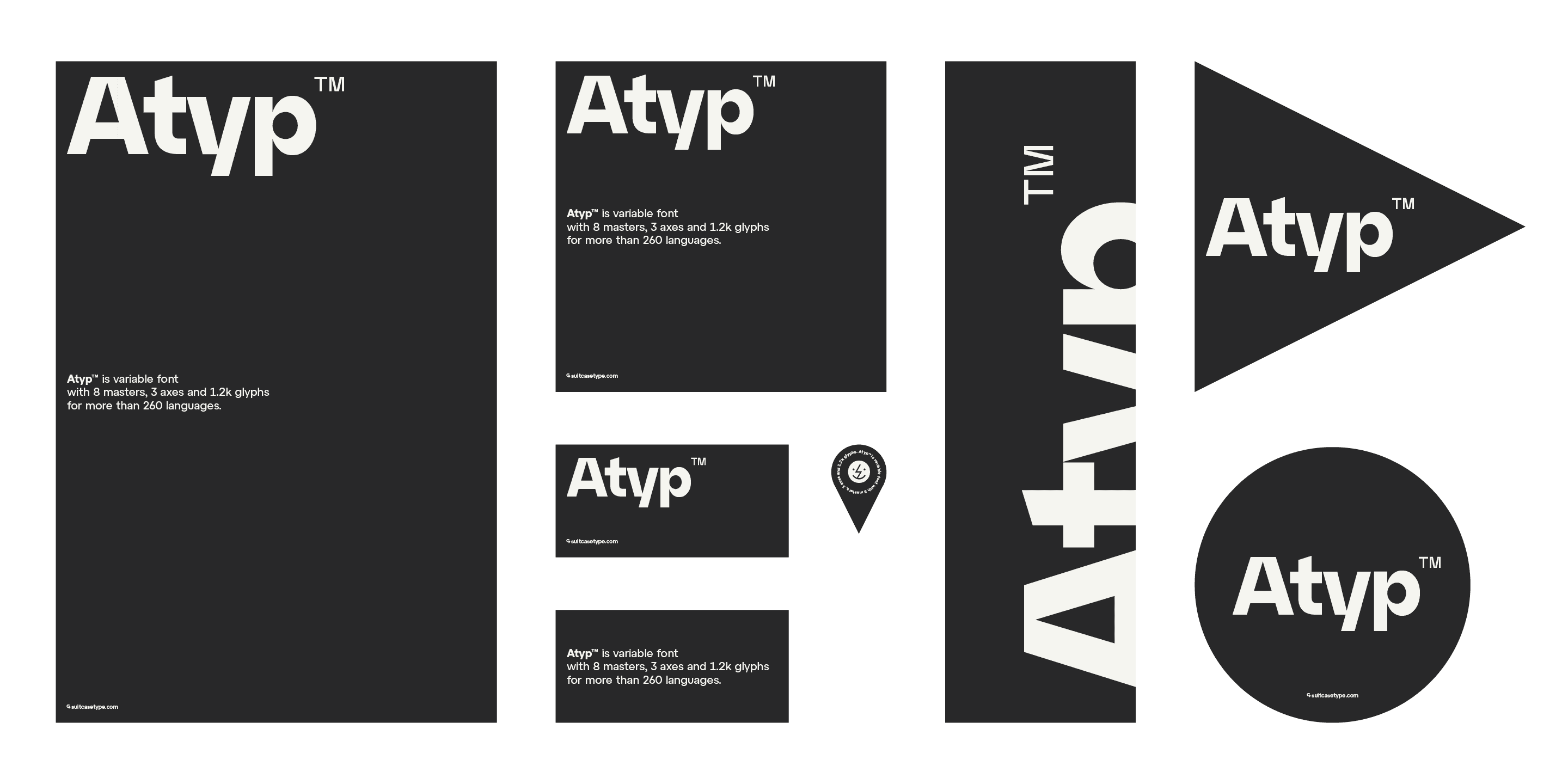
Atyp

Information

The sources of inspiration for the Atyp typeface are spread out widely both stylistically and chronologically. The basic proportions of the uppercase refer to the elementary geometric constructions of the Bauhaus. The subtle details in the drawing of the characters and the microscopic adjustments, which evoke the illusion of uniformity and mechanical purity, pay homage to the rationalism of the typefaces popular in the International Style. The increased contrast of the joints of the bowls and shoulders in the Display weight, which in certain diagonal curves transition into almost deconstructive permutations. For a change these take delight in doing things on purpose, teasing readability and breaking the rules of the new millennium's typography.
Atyp was created by adapting a typeface originally made for a commercial television station. The potential of the neutral grotesque, proven by its excellent readability on screens, gave the impetus for its preparation into an extremely wide character set with full support for three language scripts.
Coherence across all eight key masters lays the groundwork ideally for using the variable font format. The key benefits of this technology are a significant reduction in data consumption in the case of web fonts, as well as an unlimited access to the full range of styles, which in turn is a significant benefit in the area of responsive design.

  • Number of fonts in a family: 24
  • Release date: 2020
  • Current version: 1.000
  • Available formats: OTF, TTF, WOFF, WOFF2
  • Variable file: Available upon request with the purchase of the complete type family.
  • Design: Tomáš Brousil
184 languages
  • Abaza
  • Abkhaz
  • Adyghe
  • Afar
  • Afrikaans
  • Aghul
  • Albanian
  • Altai
  • Aromanian
  • Avar
  • Aymara
  • Azeri (Cyrillic)
  • Azeri (Latin)
  • Balkar
  • Bashkir
  • Basque
  • Belarusian
  • Bemba
  • Bislama
  • Bosnian
  • Breton
  • Bulgarian
  • Buryat
  • Catalan
  • Chamorro
  • Chechen
  • Cheyenne
  • Chichewa
  • Chukcha
  • Chuukese
  • Chuvash
  • Cofán
  • Cornish
  • Crimean Tatar
  • Croatian
  • Czech
  • Danish
  • Dargin
  • Dolgan
  • Dungan
  • Dutch
  • Enets
  • English
  • Esperanto
  • Estonian
  • Even
  • Evenki
  • Faroese
  • Fijian
  • Finnish
  • French
  • Frisian
  • Friulian
  • Gagauz
  • Galician
  • Ganda
  • German
  • Gikuyu
  • Greek
  • Greenlandic
  • Guaraní
  • Gwich’in
  • Haitian
  • Hawaiian
  • Hungarian
  • Icelandic
  • Ido
  • Igbo
  • Indonesian
  • Ingush
  • Interlingua
  • Irish Gaelic
  • Italian
  • Itelmen
  • Javanese
  • Kabardian
  • Kalmyk
  • Karakalpak
  • Karelian
  • Kashubian
  • Kazakh
  • Khakas
  • Khanty
  • Kinyarwanda
  • Kirghyz
  • Kiribati
  • Kirundi
  • Kituba
  • Komi
  • Koryak
  • Kumyk
  • Kurdish (Latin)
  • Ladin
  • Latvian
  • Lezgian
  • Lithuanian
  • Luxemburgish
  • Macedonian
  • Malagasy
  • Malay
  • Maltese
  • Manci
  • Manx
  • Māori
  • Mari
  • Marshallese
  • Moldovan
  • Montenegrin
  • Mordvin (Erzya)
  • Mordvin (Moksha)
  • Náhuatl
  • Nanai
  • Nauruan
  • Navajo
  • Ndebele (Northern)
  • Ndebele (Southern)
  • Nenets
  • Nganasan
  • Nogai
  • Norfuk
  • Norn
  • Norwegian (Bokmål)
  • Occitan
  • Ossetic
  • Palauan
  • Papiamento
  • Pinyin
  • Polish
  • Portuguese
  • Quechua
  • Rhaeto-Romanic
  • Romaji
  • Romanian
  • Russian
  • Rusyn
  • Rutul
  • Sámi (Inari)
  • Sámi (Lule)
  • Sámi (Northern)
  • Sámi (Southern)
  • Samoan
  • Sango
  • Sanskrit transliteration
  • Sardinian
  • Scottish Gaelic
  • Selkup
  • Serbian
  • Seychelles Creole
  • Shona
  • Silesian
  • Slovak
  • Slovene
  • Somali (Latin)
  • Sotho
  • Spanish
  • Swahili
  • Swati
  • Swedish
  • Tabasaran
  • Tagalog (Filipino)
  • Tahitian
  • Tajik
  • Tatar
  • Tetum
  • Tok Pisin
  • Tokelauan
  • Tongan
  • Tsonga
  • Tswana
  • Turkish
  • Turkmen
  • Tuva
  • Tuvalu
  • Udmurt
  • Uighur
  • Ukrainian
  • Uzbek
  • Veps
  • Vietnamese
  • Welsh
  • Wolof
  • Xhosa
  • Yakut
  • Zulu

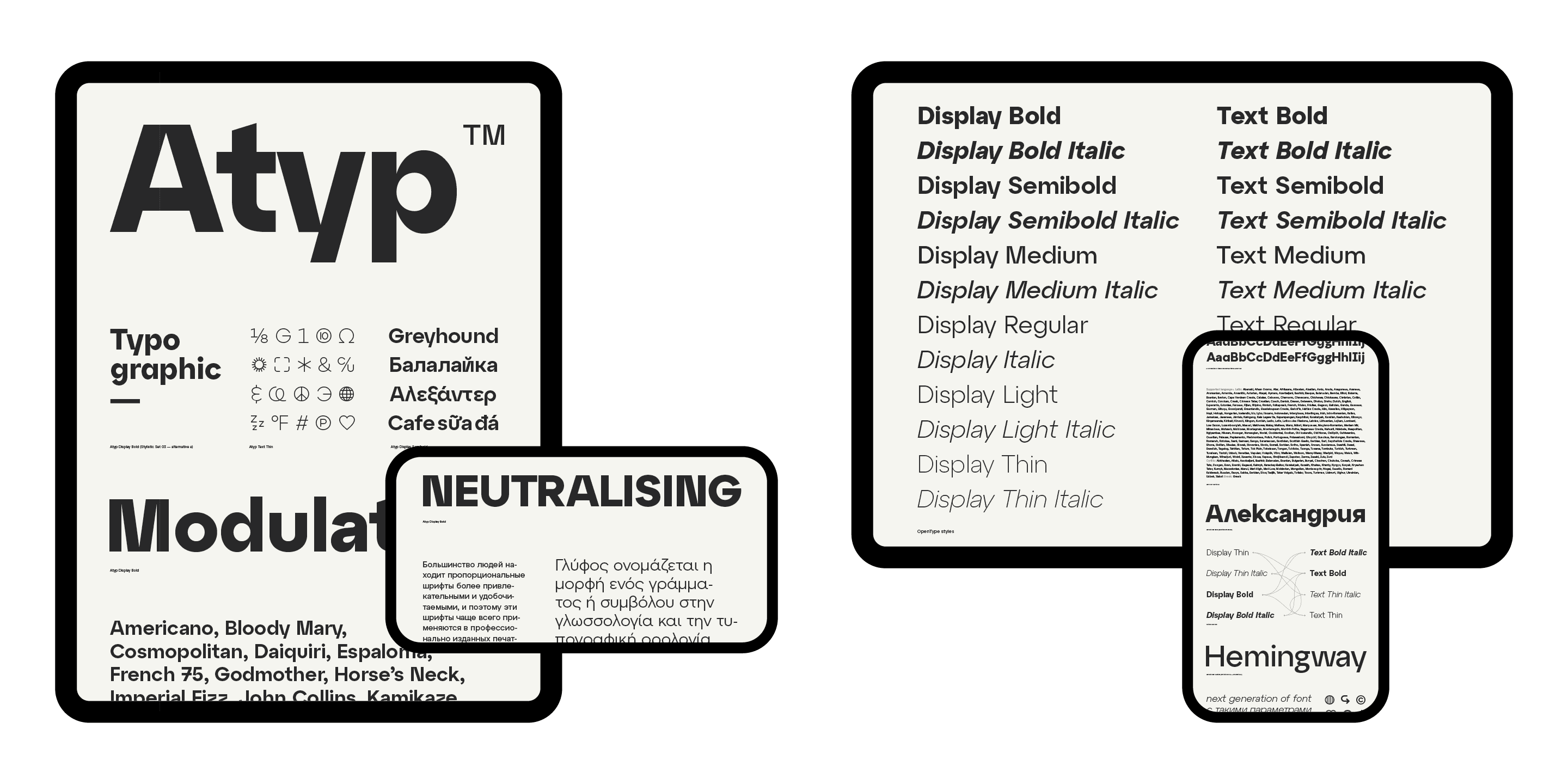
Styles

Display Thin 
Display Thin Italic 
Display Light 
Display Light Italic 
Display Regular 
Display Italic 
Display Medium 
Display Medium Italic 
Display Semibold 
Display Semibold Italic 
Display Bold 
Display Bold Italic
Text Thin 
Text Thin Italic 
Text Light 
Text Light Italic 
Text Regular 
Text Italic 
Text Medium 
Text Medium Italic 
Text Semibold 
Text Semibold Italic 
Text Bold 
Text Bold Italic

Specimen

Atyp Display Thin

from 75 EUR

Bluegrass

Atyp Display Thin Italic

from 75 EUR

University

Atyp Display Light

from 75 EUR

Enjoyable

Atyp Display Light Italic

from 75 EUR

Roughing

Atyp Display Regular

from 75 EUR

Adoption

Atyp Display Italic

from 75 EUR

Definitive

Atyp Display Medium

from 75 EUR

Mentality

Atyp Display Medium Italic

from 75 EUR

Ecologist

Atyp Display Semibold

from 75 EUR

Brigadier

Atyp Display Semibold Italic

from 75 EUR

Linoleum

Atyp Display Bold

from 75 EUR

Aphetize

Atyp Display Bold Italic

from 75 EUR

Godpapa

Atyp Display Bold

from 75 EUR

Improvisation in engineering involves solving problems on the spur of the moment using whatever tools and materials are immediately available.

Atyp Display Bold Italic

from 75 EUR

In engineering, improvisation is often necessary due to emergencies, trade restrictions, product obsolescence or loss of manufacturer support.

Atyp Text Medium

from 75 EUR

A significant portion of early computer music research was inspired by the long-standing relationship between music and mathematics, a connection already recognized by the Ancient Greeks in their concept of the “harmony of the spheres”. One of the earliest instances of computer-generated music dates back to 1950, when the CSIR Mark 1 (later renamed CSIRAC) in Australia was used to produce musical melodies. Although there were claims that computers in the United States and England may have played music earlier, detailed research has found no reliable evidence to support those reports. Such assumptions likely arose because early computers emitted sounds, leading people to speculate about their musical capabilities. The CSIR Mark 1 was developed by Trevor Pearcey and Maston Beard in the late 1940s. In the early 1950s, mathematician Geoff Hill programmed it to play well-known tunes. This marked the first documented use of a digital computer for music. While the original performances were not recorded, they have since been carefully reconstructed. In 1951, the machine publicly performed the “Colonel Bogey March”. However, its use remained limited to playing existing melodies rather than advancing musical composition. In England, the first computer-generated music was produced later in 1951, when Christopher Strachey programmed the Ferranti Mark 1 to play the British National Anthem. That same year, a BBC recording captured excerpts of several pieces, including the anthem, “Baa, Baa, Black Sheep”, and “In the Mood”. This recording is considered the earliest surviving audio of a computer performing music.

Atyp Text Medium

from 75 EUR

During the 1950s, two important developments emerged: digital sound synthesis and algorithmic composition. Pioneers such as Lejaren Hiller and Leonard Isaacson conducted experiments in algorithmic composition, culminating in the 1957 premiere of the Illiac Suite for string quartet. Around the same time, Max Mathews at Bell Laboratories developed the influential MUSIC I program and its successors, helping to establish computer music as a field of study. Composer James Tenney was among the first professionals to work extensively with digital synthesis, creating compositions using the MUSIC III system in the early 1960s. He was later succeeded at Bell Labs by Jean-Claude Risset, who explored the synthesis of instrumental sounds and composed innovative computer-based works. Early computer music systems typically did not operate in real time. Programs often ran for hours or even days on expensive machines to produce only a few minutes of audio. To address this limitation, hybrid systems were developed that combined digital control with analog synthesizers. Notable examples include the GROOVE system created by Max Mathews and the MUSYS system developed by Peter Zinovieff, both introduced in 1969. In Japan, experiments with computer music began in 1962, when Professor Sekine from Keio University and engineer Hayashi from Toshiba worked with the TOSBAC computer. Their collaboration produced a composition titled TOSBAC Suite, which was influenced by earlier developments in algorithmic music. Later contributions included a piece by Kenjiro Ezaki presented at Expo70 in Osaka, as well as Panoramic Sonore (1974) by music critic Akimichi Takeda. Ezaki also published an article in 1970 titled “Contemporary Music and Computers”. Much of the subsequent research in Japan focused on commercial applications in popular music, although some composers explored more advanced systems such as the Fairlight in the 1970s. By the late 1970s, computer music technology began to reach the commercial market. Systems like the Roland MC-8 Microcomposer, released in 1978, used microprocessors to control analog synthesizers. Around the same time, the introduction of affordable digital chips and microcomputers enabled real-time sound generation. In the 1980s, Japanese personal computers such as the NEC PC-88 were equipped with FM synthesis sound chips and supported audio programming through languages like Music Macro Language (MML), as well as MIDI interfaces.

Atyp Text Medium

from 75 EUR

Компьютерлік музыкадағы кейінгі дамуларда Gottfried Michael Koenig және Iannis Xenakis сияқты композиторлар компьютерлерді тек музыкалық партитураларды жасау үшін ғана емес, сонымен қатар дыбыстардың өзін тікелей құрастыру үшін де қолдана бастады. Кёниг алгоритмдік композицияға назар аударып, өзінің сериялық композиция әдістерін компьютерлік бағдарламаларға енгізді. Оның тәсілі математикалық есептеулерді музыкалық нотацияның кодталған түріне айналдыруға негізделді. Бұл кейін жазбаша партитураларға айналдырылып, музыканттар тарапынан орындалуы мүмкін болды. Оның Project 1 және Project 2 бағдарламалары осы әдістің маңызды мысалдары болып табылады. Ал Ксенакис композицияға математикалық абстракция тұрғысынан қарады, яғни формалды математикалық идеяларды музыкаға тікелей қолданудың шегін зерттеді. Екі композитор да математиканы қолданғанымен, Кёниг құрылымды нотацияға аударуға басымдық берсе, Ксенакис неғұрлым эксперименттік және тұжырымдамалық бағытты ұстанды. Кейінірек Кёниг өз жұмысын дыбыс синтезіне дейін кеңейтті, бұл компьютерлерге тек нотацияны емес, дыбыстың өзін тікелей генерациялауға мүмкіндік берді. Бұған мысал ретінде SSP бағдарламасын айтуға болады, ол есептеу процестері арқылы дыбыс жасауға мүмкіндік берді. Бұл жұмыстардың көпшілігі 1970-жылдары Сонология институтында жүзеге асырылды.

Atyp Text Medium

from 75 EUR

Η μοντελοποίηση ύφους στη μουσική περιλαμβάνει τη δημιουργία μιας υπολογιστικής αναπαράστασης της μουσικής δομής που αποτυπώνει βασικά στιλιστικά χαρακτηριστικά από υπάρχοντα δεδομένα. Στατιστικές μέθοδοι χρησιμοποιούνται για τον εντοπισμό επαναλαμβανόμενων μοτίβων ή επαναλήψεων, τα οποία μπορούν στη συνέχεια να ανασυνδυαστούν για τη δημιουργία νέου μουσικού υλικού. Αυτή η προσέγγιση καθιστά επίσης δυνατή τη μίξη στυλ μέσω της ανάλυσης συλλογών μουσικής από διαφορετικές πηγές και της συγχώνευσης των χαρακτηριστικών τους. Ο αυτοσχεδιασμός από μηχανές βασίζεται σε μια παράδοση στατιστικής μοντελοποίησης στη μουσική που χρονολογείται από πρώιμα πειράματα, όπως το Illiac Suite και το έργο του Ιάννη Ξενάκη, ο οποίος εφάρμοσε έννοιες όπως οι αλυσίδες Markov και οι στοχαστικές διαδικασίες. Οι σύγχρονες τεχνικές επεκτείνουν αυτές τις ιδέες χρησιμοποιώντας εργαλεία όπως η συμπίεση δεδομένων χωρίς απώλειες, τα δέντρα επιθημάτων πρόβλεψης (prediction suffix trees) και οι αλγόριθμοι αντιστοίχισης συμβολοσειρών. Ένα από τα πρώτα παραδείγματα μίξης ύφους αναπτύχθηκε από τον Shlomo Dubnov, ο οποίος συνδύασε πολλαπλά μουσικά μοντέλα σε ένα ενιαίο πλαίσιο. Αργότερα, ο αλγόριθμος factor oracle—μια αποδοτική δομή για την αναγνώριση προτύπων—προσαρμόστηκε στη μουσική από τον Gérard Assayag και τον Dubnov, αποτελώντας τη βάση για αρκετά συστήματα που επιτρέπουν τη στιλιστική ανασύνθεση και τον αυτοσχεδιασμό σε πραγματικό χρόνο. Πρώιμες υλοποιήσεις της στατιστικής μοντελοποίησης ύφους περιλάμβαναν τη μέθοδο LZify στο OpenMusic, ακολουθούμενες από το σύστημα Continuator, που αναπτύχθηκε από τον François Pachet το 2002. Το σύστημα αυτό επέτρεψε διαδραστικό αυτοσχεδιασμό από μηχανή, ερμηνεύοντας τεχνικές συμπίεσης δεδομένων μέσω μοντέλων Markov σε πραγματικό χρόνο. Επιπλέον υλοποιήσεις αυτοσχεδιασμού βασισμένες στο factor oracle έχουν αναπτυχθεί σε περιβάλλοντα όπως το MATLAB και άλλα υπολογιστικά πλαίσια. Ένα ακόμη σημαντικό σύστημα είναι το OMax, που αναπτύχθηκε στο IRCAM. Ενσωματώνει εργαλεία όπως το OpenMusic και το Max και βασίζεται σε έρευνα σχετικά με τη στιλιστική μοντελοποίηση και τον αυτοσχεδιασμό με τη βοήθεια υπολογιστή. Μια βασική πρόκληση σε αυτά τα συστήματα είναι η μετατροπή συνεχών ηχητικών σημάτων σε διακριτές συμβολικές αναπαραστάσεις που μπορούν να υποστούν υπολογιστική επεξεργασία. Το ζήτημα αυτό έχει αντιμετωπιστεί μέσω του Variable Markov Oracle (VMO), το οποίο χρησιμοποιεί κριτήρια βασισμένα στην πληροφορία για να καθορίσει την πιο ουσιαστική αναπαράσταση των μουσικών χαρακτηριστικών.

OpenType features

INFINITY

Glyphs

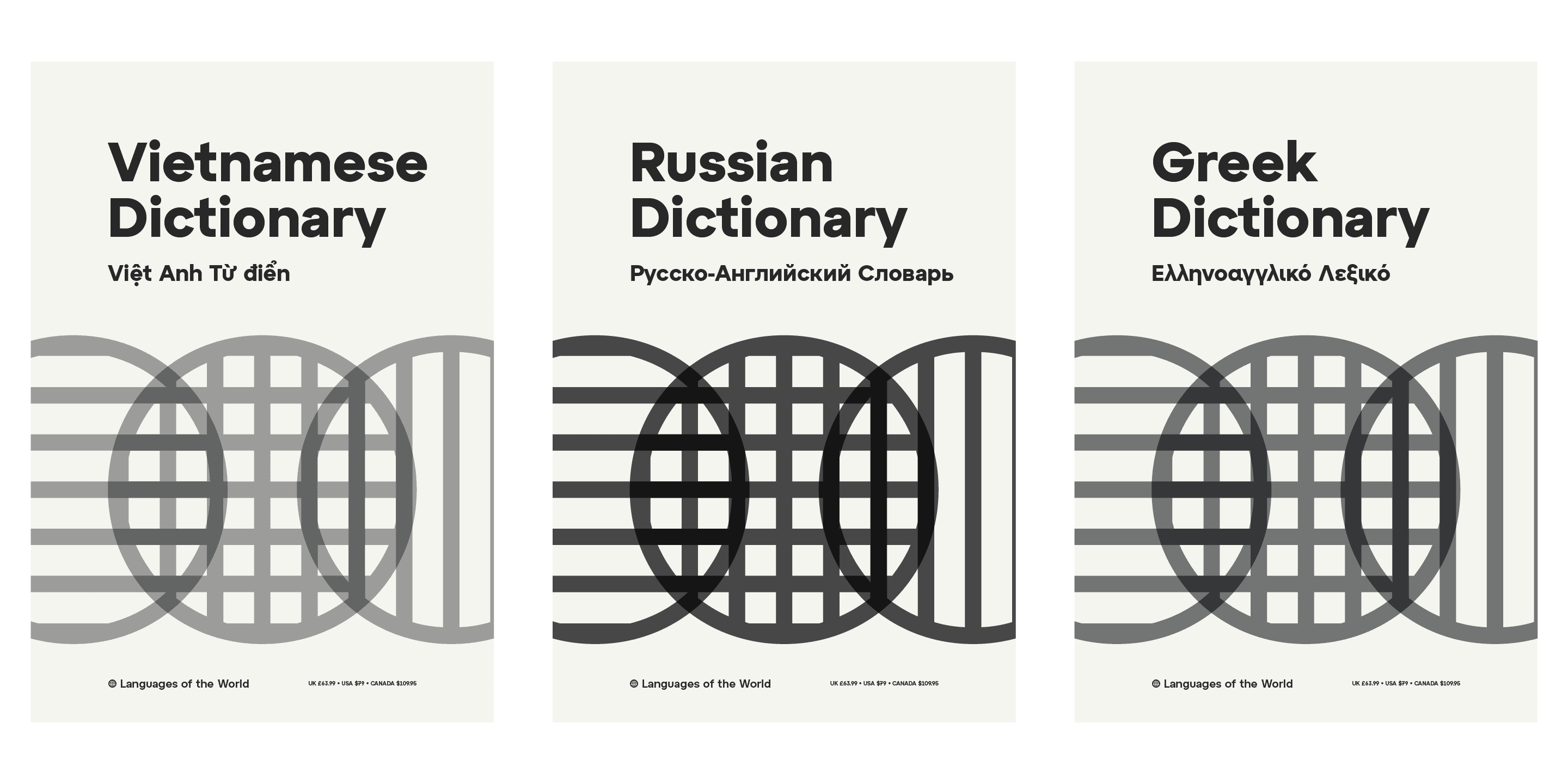
Atyp in use