Jaroslav

Information

We think of the Latin alphabet as fixed and unchanging. From history, however, we know that what we understand today as definitive and clearly codified has been examined and revised numerous times. Aside from the crowning monumental Roman capitals, this is why we know the somewhat uncouth Greek inscriptions, in old uncial manuscripts we find lush rounded shapes, and the strict, vertical (and unreadable) blackletters have been preserved from the high Middle Ages. But typographic modernism did not give up on creative experimentation. While German typographers at the beginning of the 20th century explored the possibilities and boundaries of geometrically-constructed types, Czech architects and designers sought to find a “national style,” a unique artistic language for the newly-formed state of Czechoslovakia.
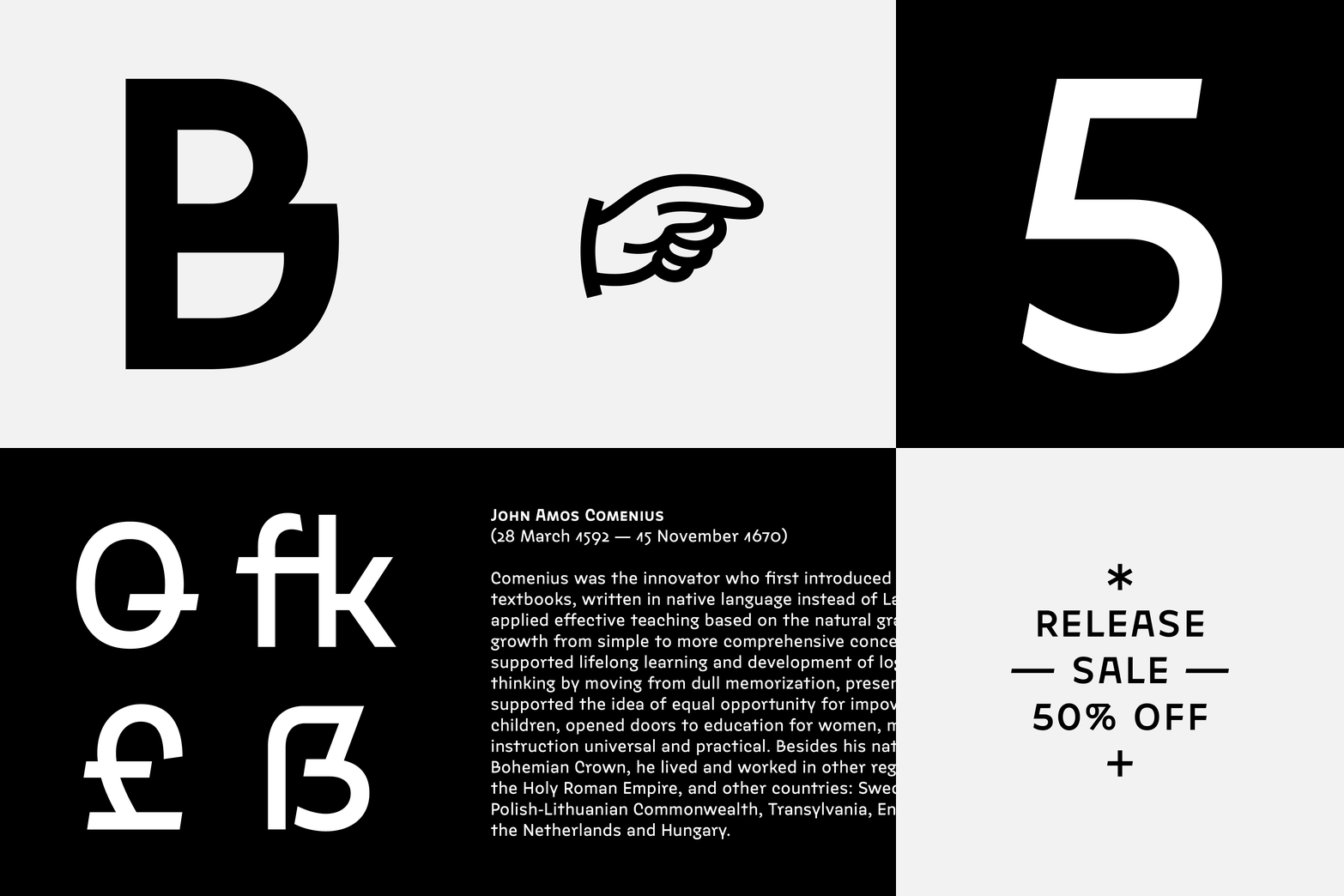
While the Jaroslav type family respects efforts to find new expression in an old and seemingly exhausted Latin, it reflects everything that was to come in the last hundred years. For this reason, Jaroslav is primarily a reaction to the problem of the exaggerated unification of sans-serif letterforms. Its innovative approach to the lowercase and uppercase characters refreshes the clearly dried-up concept of the grotesque, and brings to it again the much-needed principles of freedom and creative playfulness.

The Jaroslav typeface is a tribute to the typography of Jaroslav Benda.

  • Number of fonts in a family: 10
  • Release date: 2017
  • Current version: 1.001
  • Available formats: OTF, TTF, WOFF, WOFF2
  • Variable file: Available upon request with the purchase of the complete type family.
  • Design: Tomáš Brousil
117 languages
  • Afar
  • Afrikaans
  • Albanian
  • Aromanian
  • Aymara
  • Azeri (Latin)
  • Basque
  • Bemba
  • Bislama
  • Bosnian
  • Breton
  • Catalan
  • Chamorro
  • Cheyenne
  • Chichewa
  • Chuukese
  • Cofán
  • Cornish
  • Croatian
  • Czech
  • Danish
  • Dutch
  • English
  • Esperanto
  • Estonian
  • Faroese
  • Fijian
  • Finnish
  • French
  • Frisian
  • Friulian
  • Galician
  • Ganda
  • German
  • Gikuyu
  • Greenlandic
  • Guaraní
  • Gwich’in
  • Haitian
  • Hawaiian
  • Hungarian
  • Icelandic
  • Ido
  • Indonesian
  • Interlingua
  • Irish Gaelic
  • Italian
  • Javanese
  • Kashubian
  • Kinyarwanda
  • Kiribati
  • Kirundi
  • Kituba
  • Kurdish (Latin)
  • Ladin
  • Latvian
  • Lithuanian
  • Luxemburgish
  • Malagasy
  • Malay
  • Maltese
  • Manx
  • Māori
  • Marshallese
  • Montenegrin
  • Náhuatl
  • Nauruan
  • Navajo
  • Ndebele (Northern)
  • Ndebele (Southern)
  • Norfuk
  • Norn
  • Norwegian (Bokmål)
  • Occitan
  • Palauan
  • Papiamento
  • Pinyin
  • Polish
  • Portuguese
  • Quechua
  • Rhaeto-Romanic
  • Romaji
  • Romanian
  • Sámi (Inari)
  • Sámi (Lule)
  • Sámi (Northern)
  • Sámi (Southern)
  • Samoan
  • Sango
  • Sardinian
  • Scottish Gaelic
  • Seychelles Creole
  • Shona
  • Silesian
  • Slovak
  • Slovene
  • Somali (Latin)
  • Sotho
  • Spanish
  • Swahili
  • Swati
  • Swedish
  • Tagalog (Filipino)
  • Tahitian
  • Tetum
  • Tok Pisin
  • Tokelauan
  • Tongan
  • Tsonga
  • Tswana
  • Turkish
  • Tuvalu
  • Veps
  • Welsh
  • Wolof
  • Xhosa
  • Zulu

Styles

Light 
Light Italic 
Regular 
Italic 
Medium 
Medium Italic 
Semibold 
Semibold Italic 
Bold 
Bold Italic

Specimen

Jaroslav Light

from 59 EUR

Capriccio

Jaroslav Light Italic

from 59 EUR

Angelship

Jaroslav Regular

from 59 EUR

Intelligize

Jaroslav Italic

from 59 EUR

Grabbling

Jaroslav Medium

from 59 EUR

Bismarck

Jaroslav Medium Italic

from 59 EUR

Spikiness

Jaroslav Semibold

from 59 EUR

Necklace

Jaroslav Semibold Italic

from 59 EUR

Autoriser

Jaroslav Bold

from 59 EUR

Cynicism

Jaroslav Bold Italic

from 59 EUR

Imprinter

Jaroslav Medium

from 59 EUR

Plato was born sometime between 428 and 423 BC into a prominent and aristocratic family in Athens. Through his mother, Perictione, he was believed to be a descendant of Solon, who is often credited with establishing key foundations of Athenian democracy.

Jaroslav Medium Italic

from 59 EUR

Plato had two brothers, Glaucon and Adeimantus—both of whom appear as characters in his work Republic—as well as a sister, Potone, and a half-brother, Antiphon. During his early years, Athens was engaged in the Peloponnesian War with Sparta.

Jaroslav Medium

from 59 EUR

In his youth, Plato encountered Socrates, who became both his teacher and his greatest source of inspiration. Their first meetings likely took place among other Athenian youths in the palaestra, similar to scenes where figures like Lysis and Menexenus engage in philosophical discussions with Socrates. Before long, Plato joined Socrates’ close circle, regularly meeting with him and his followers. Socrates, alongside the sophists of his time, shifted attention away from the natural philosophy of earlier Greek thinkers and instead explored ethical and political questions. He examined the beliefs of others through a structured form of inquiry now known as the Socratic method. Socrates’ profound influence on Plato is evident in his dialogues. Plato never presents his own voice directly; instead, Socrates appears as the central speaker in nearly all of them, with the notable exception of Laws. In some works, such as Timaeus and Statesman, Socrates plays only a minor role. Some scholars point out that Socrates’ well-known use of irony makes it uncertain whether the views expressed by Plato’s Socrates always reflect genuine beliefs. Other ancient authors portray Socrates differently: Xenophon and Aristophanes offer accounts that contrast with Plato’s depiction. Aristotle, meanwhile, distinguishes between the ideas of Plato and Socrates, especially regarding the concept of Forms. He suggests that Socrates’ understanding of forms could be derived from studying the natural world, whereas Plato described Forms as existing beyond ordinary human experience. Reconciling these differing portrayals—often referred to as the Socratic problem—remains an ongoing debate among scholars, particularly concerning the exact relationship between Plato and Socrates.

Jaroslav Medium

from 59 EUR

Platonism refers to the philosophy of Plato and the systems of thought that developed from it. It is often contrasted with nominalism or anti-realism. Throughout history, Platonism has had a major impact on Western philosophy. At its core, it affirms the real existence of Forms, or abstract entities, introduced to address the problem of universals. These abstract objects are said to exist in a distinct realm, separate both from the physical world we perceive and from the inner world of human consciousness. This idea can apply to properties, categories, propositions, meanings, numbers, sets, and truth values. Plato’s theory was originally an attempt to reconcile two different views of reality. On one side was the ever-changing, perceptible world associated with Heraclitus and studied by natural science. On the other was the unchanging, intelligible reality associated with Parmenides and explored through mathematics. Geometry played a key role in shaping Plato’s thinking, reflecting the influence of Pythagorean ideas. In his dialogues, the Forms are described as perfect models, while objects in the everyday world are seen as imperfect copies of them. One of the most well-known ancient criticisms of this theory is Aristotle’s “Third Man” argument. Plato founded the Academy, which became a central institution for philosophical development. In the 3rd century BC, Arcesilaus introduced Academic skepticism, which remained influential in the school for some time. Around 90 BC, Antiochus moved away from skepticism and incorporated elements of Stoicism, marking the beginning of what is known as Middle Platonism. Later, in the 3rd century AD, Plotinus expanded Platonism by adding mystical dimensions, giving rise to Neoplatonism. In this view, the highest principle of reality is the One, or the Good, which is the source of everything. Through virtue and contemplation, the soul can ascend and achieve unity with this ultimate principle. Many Platonic ideas were later adopted by Christian thinkers. The concept of Forms was interpreted as the thoughts of God, while Neoplatonism strongly influenced Christian mysticism, particularly in the work of Augustine, who was deeply inspired by Plotinus. These ideas played a significant role in shaping Western Christian philosophy. Platonic thought experienced renewed interest during the Renaissance and continues to influence modern philosophy, especially in discussions of mathematical Platonism within the philosophy of mathematics.

OpenType features

Internationale

Glyphs

Jaroslav in use