Gloriola

Information

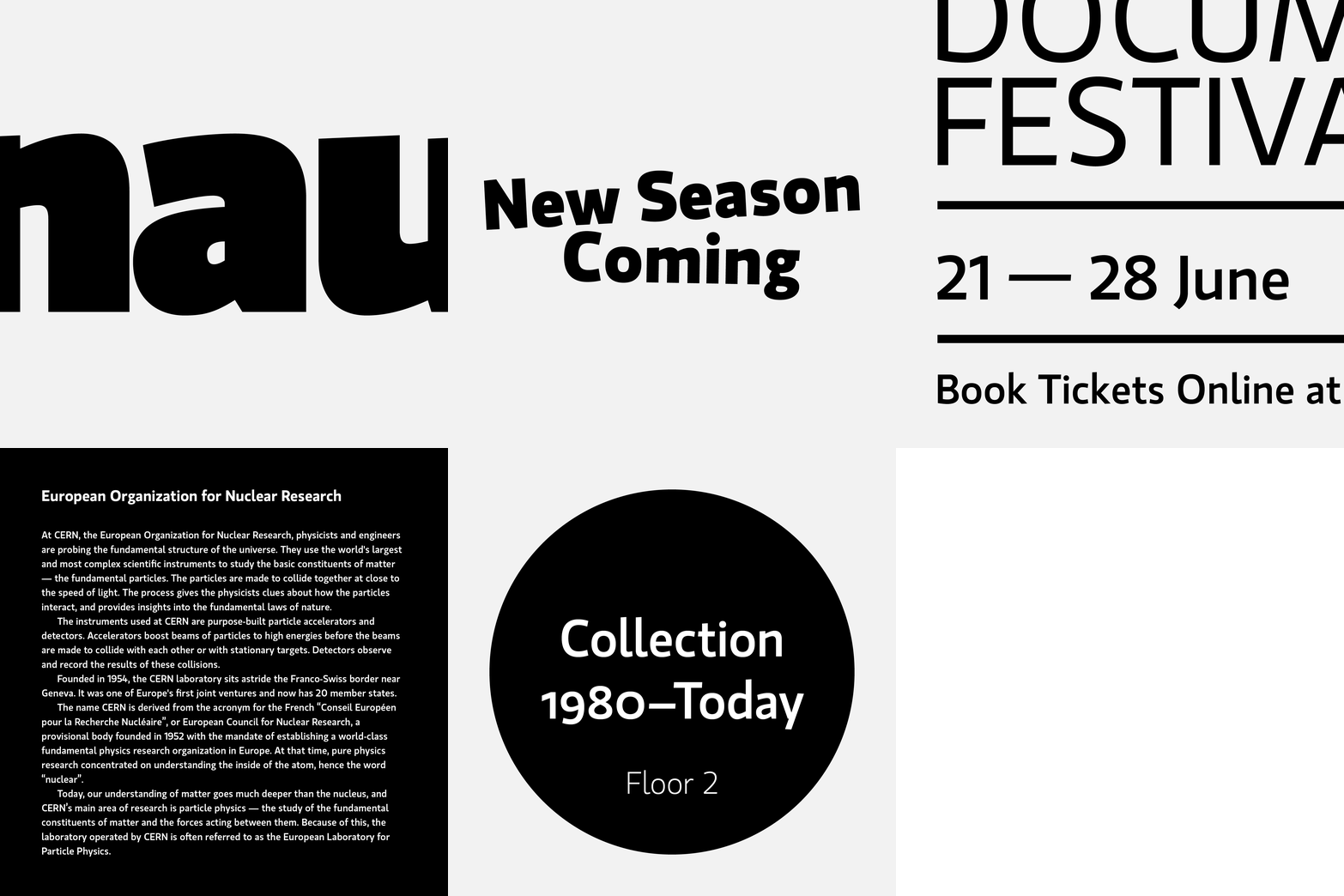
If you feel that the differences between fonts are starting to blur, you’ll appreciate this modern typeface family, which builds on the legacy of humanist sans-serif fonts while not shying away from adding a touch of flair. The combination of restrained, unobtrusive uppercase letters and lowercase with distinctive ascenders, a slightly compressed width, and an atypical design makes a sufficiently original contribution to current efforts to update the text sans-serif.
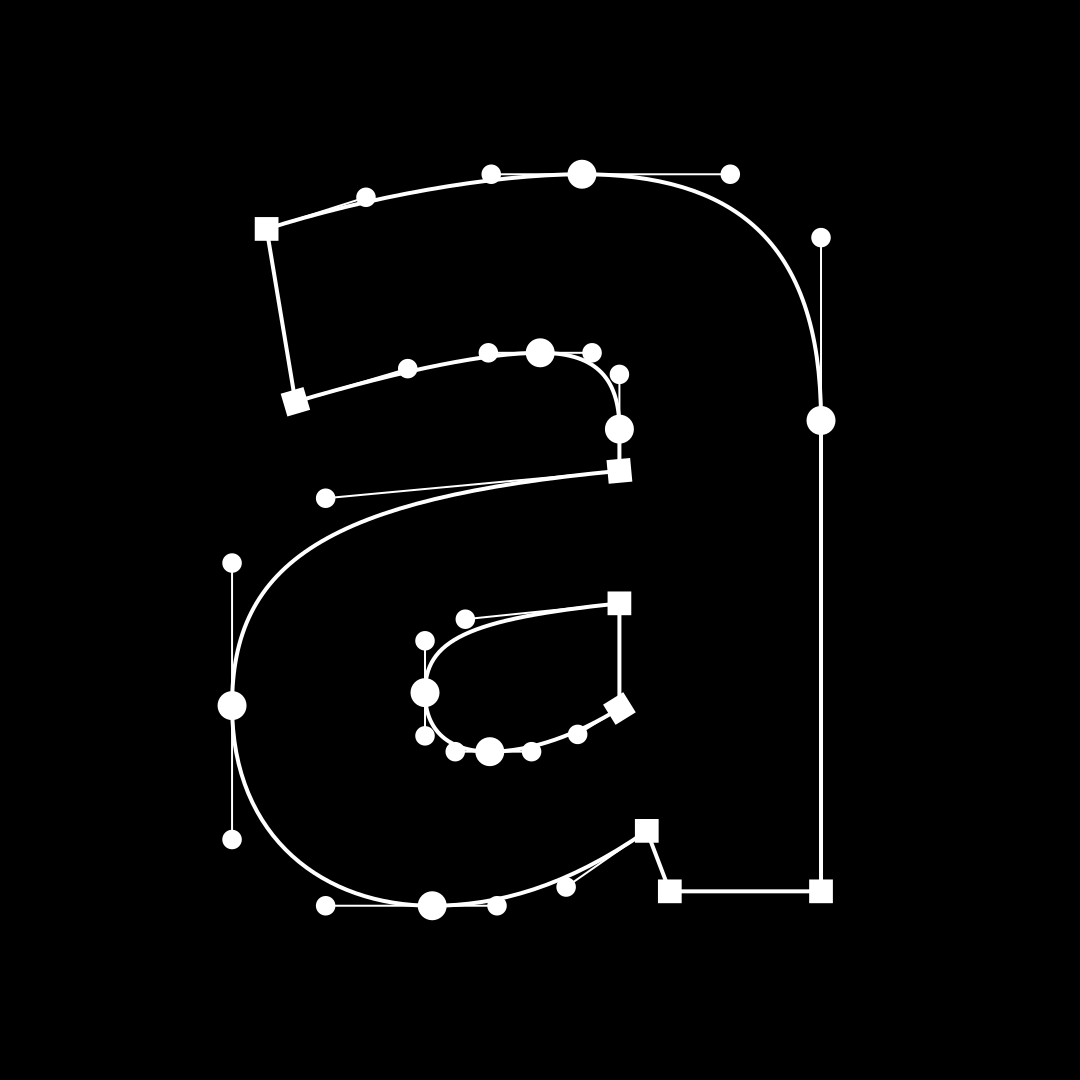
In addition to the curves’ clear, distinct connection to the stem, the open shape and angular treatment of the curved strokes are striking, creating a pleasant tension within the perfectly legible text. The typeface is monolinear; even in the boldest weights, the contrast does not exceed the minimum necessary for optical balance.
The range of weights largely determines the font’s versatility, especially if you specialize in creating publications and extensive visual styles. Gloriola includes five weights from Light to Bold, with italics, plus four additional Display weights — Hair, Thin, Black, and Fat — that cover the outermost extremes. These have shortened ascenders and serve as an excellent stylistic complement to body text, where you need to grab the reader’s attention with stark contrast.

  • Number of fonts in a family: 14
  • Release date: 2007
  • Current version: 1.000
  • Available formats: OTF, TTF, WOFF, WOFF2
  • Design: Tomáš Brousil
108 languages
  • Afar
  • Afrikaans
  • Albanian
  • Aromanian
  • Aymara
  • Basque
  • Bemba
  • Bislama
  • Bosnian
  • Breton
  • Catalan
  • Chamorro
  • Chichewa
  • Chuukese
  • Cofán
  • Croatian
  • Czech
  • Danish
  • Dutch
  • English
  • Esperanto
  • Estonian
  • Faroese
  • Fijian
  • Finnish
  • French
  • Frisian
  • Friulian
  • Galician
  • Ganda
  • German
  • Gikuyu
  • Greenlandic
  • Gwich’in
  • Haitian
  • Hawaiian
  • Hungarian
  • Icelandic
  • Ido
  • Indonesian
  • Interlingua
  • Irish Gaelic
  • Italian
  • Javanese
  • Kashubian
  • Kinyarwanda
  • Kiribati
  • Kirundi
  • Kituba
  • Kurdish (Latin)
  • Ladin
  • Latvian
  • Lithuanian
  • Luxemburgish
  • Malay
  • Maltese
  • Manx
  • Māori
  • Montenegrin
  • Náhuatl
  • Nauruan
  • Ndebele (Northern)
  • Ndebele (Southern)
  • Norfuk
  • Norn
  • Norwegian (Bokmål)
  • Occitan
  • Palauan
  • Papiamento
  • Polish
  • Portuguese
  • Quechua
  • Rhaeto-Romanic
  • Romaji
  • Sámi (Inari)
  • Sámi (Lule)
  • Sámi (Northern)
  • Sámi (Southern)
  • Samoan
  • Sango
  • Sardinian
  • Scottish Gaelic
  • Seychelles Creole
  • Shona
  • Silesian
  • Slovak
  • Slovene
  • Somali (Latin)
  • Sotho
  • Spanish
  • Swahili
  • Swati
  • Swedish
  • Tagalog (Filipino)
  • Tahitian
  • Tetum
  • Tok Pisin
  • Tokelauan
  • Tongan
  • Tsonga
  • Tswana
  • Turkish
  • Tuvalu
  • Veps
  • Welsh
  • Wolof
  • Xhosa
  • Zulu

Styles

Display Hair 
Display Thin 
Light 
Light Italic 
Regular 
Italic 
Medium 
Medium Italic 
SemiBold 
SemiBold Italic 
Bold 
Bold Italic 
Display Black 
Display Fat

Specimen

Gloriola Display Hair

from 59 EUR

Continuant

Gloriola Display Thin

from 59 EUR

Matriarchy

Gloriola Light

from 59 EUR

Statutable

Gloriola Light Italic

from 59 EUR

Buttonless

Gloriola Regular

from 59 EUR

Superman

Gloriola Italic

from 59 EUR

Unclassify

Gloriola Medium

from 59 EUR

Referenda

Gloriola Medium Italic

from 59 EUR

Illuminate

Gloriola SemiBold

from 59 EUR

Whatever

Gloriola SemiBold Italic

from 59 EUR

Bulgarian

Gloriola Bold

from 59 EUR

Pandemia

Gloriola Bold Italic

from 59 EUR

Erotically

Gloriola Display Black

from 59 EUR

Untypical

Gloriola Display Fat

from 59 EUR

Casuality

Gloriola Display Fat

from 59 EUR

Homer describes a more-than-natural light around the heads of heroes in battle.

Gloriola Regular

from 59 EUR

Halos appear in Islamic art across different regions and historical periods, particularly in Persian miniatures as well as in Mughal and Ottoman works influenced by this tradition. Radiant or flaming halos, derived from Buddhist visual culture, often surround angels, and comparable motifs are frequently depicted around Muhammad and other revered human figures. From the early 17th century onward, simpler circular halos began to appear in portraits of Mughal emperors, and later also in representations of Rajput and Sikh rulers.

Gloriola Italic

from 59 EUR

Although local traditions already existed, art historians generally suggest that the Mughal use of halos was influenced by European religious imagery, while at the same time reflecting a long-standing Persian concept of divine charisma associated with kingship. Ottoman artists typically avoided portraying sultans with halos, despite their role as caliphs. In Chinese art, halos are mainly shown when emperors are depicted in the role of Buddhist religious figures, a position some rulers considered appropriate to adopt.

Gloriola Regular

from 59 EUR

Square halos were occasionally used to represent living individuals in donor portraits created in Italy between approximately 500 and 1100. Most surviving examples depict popes and other important figures in mosaics in Rome, including the image known as Episcopa Theodora, believed to portray the mother of a contemporary pope. In these cases, the square halo appears to indicate that the person was alive at the time the artwork was made, rather than suggesting sainthood or future canonization. A later example appears in a manuscript dated 1056–1086, showing Desiderius, Abbot of Monte Cassino, who later became pope. According to a 9th-century account written by John, a deacon of Rome, Pope Gregory the Great also had himself portrayed with a square halo. A figure thought to represent Moses in the 3rd-century synagogue at Dura-Europos is likewise depicted with a square halo, in contrast to the absence of round halos in that setting. Similar examples of square halos appear in donor portraits in the 7th-century church of St Demetrios in Thessaloniki. Allegorical representations of virtues are sometimes shown with hexagonal halos. Another variation is the scalloped halo, which may appear as a series of radiating bars, frequently seen in manuscripts associated with the Carolingian Ada School, such as the Ada Gospels. A radiance surrounding the entire body is often described as an aureole or glory. This effect is typically used for Christ or the Virgin Mary, and occasionally for saints, especially those believed to have been seen enveloped in divine light. The aureole is often depicted in the form of a mandorla, an almond-shaped figure surrounding the body, particularly in images of Christ in Majesty, where a halo may also be present.

OpenType features

REDESIGN

Glyphs

Gloriola in use