Tabac

Information

Collaboration with graphic designers allows us to carefully assess their needs when selecting typefaces for specific applications. This enables us to take their practical requirements into account and create typefaces specifically tailored to those needs. It was precisely these needs that formed the basis for the Tabac typeface system.
The basic idea was high contrast variability, allowing the typeface to span several classification groups, from text to headline type. To achieve this, we used the principle of scaling stroke width by gradually, subtly thickening hairline strokes. The entire text typeface family is available in four subtle optical grades that subtly adjust the darkness of the typeset. This is extremely useful for fine-tuning the final layout of printed materials based on the material used, print quality, or printing technique, as the typeface's width proportions—and thus the final typeset—remain unchanged.
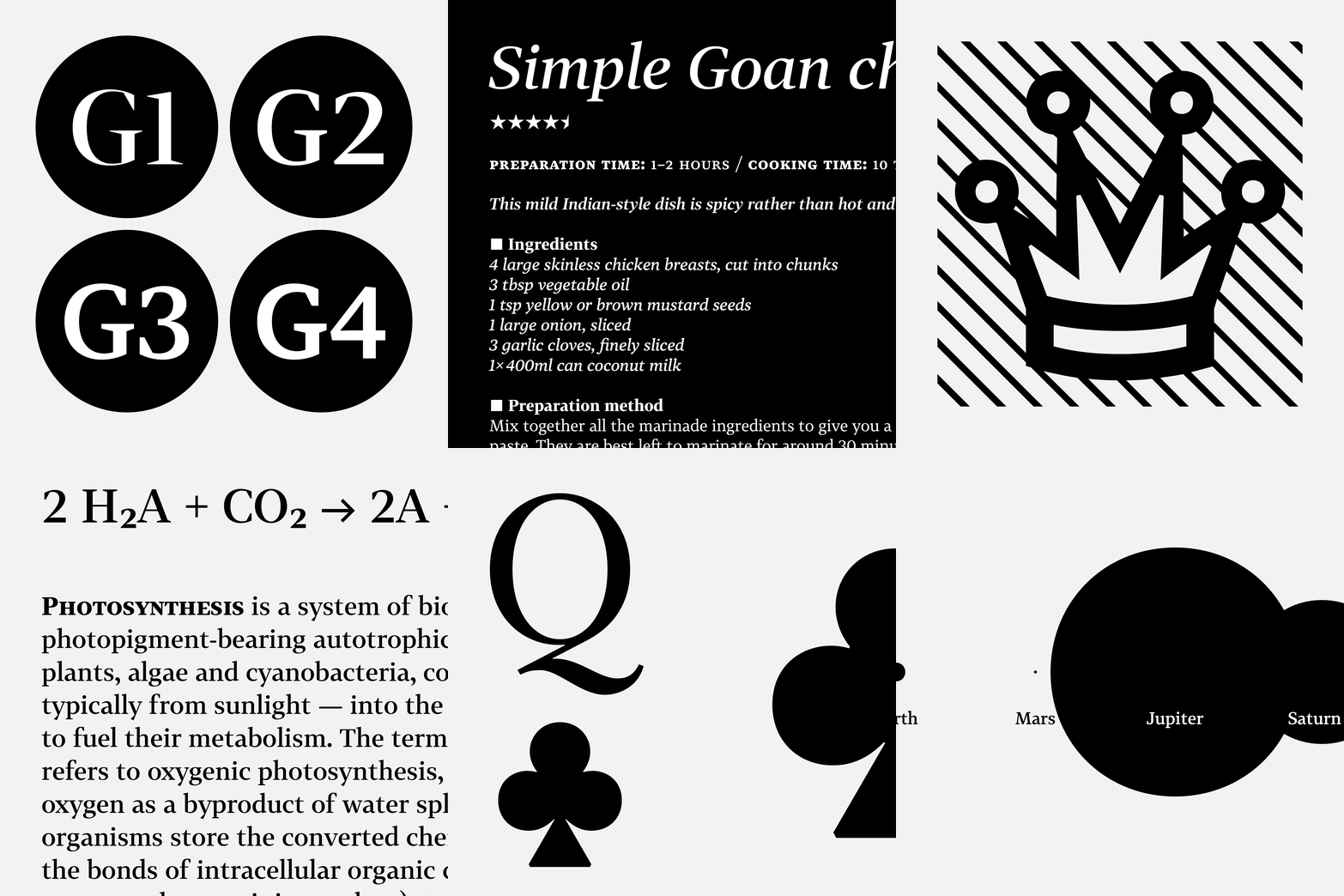
Tabac is a static, modern-style serif typeface with distinctive wedge-shaped serifs designed for typesetting newspapers, magazines, and books. By scaling stroke width across all weights, including bold weights, the system achieves a high degree of contrast variability. The typeface has an open design without any unusual shape variations, as one would expect from a text typeface. Nevertheless, the austere design creates a pleasant tension on the line, and in headline sizes, its strong character really stands out. The italic is slightly thinner than the corresponding upright style. Lowercase letters, where the design allows, have as identical a width as possible to the upright style. This is to ensure that the column length changes as little as possible when a section of text is highlighted. Sufficient legibility is achieved through much smoother connections of secondary strokes to the stem and through shape modulation.

This text family forms the basis for the entire typeface system of the Tabac superfamily.

  • Number of fonts in a family: 32
  • Release date: 2010
  • Current version: 1.001
  • Available formats: OTF, TTF, WOFF, WOFF2
  • Design: Tomáš Brousil
109 languages
  • Afar
  • Afrikaans
  • Albanian
  • Aromanian
  • Aymara
  • Basque
  • Bemba
  • Bislama
  • Bosnian
  • Breton
  • Catalan
  • Chamorro
  • Chichewa
  • Chuukese
  • Cofán
  • Croatian
  • Czech
  • Danish
  • Dutch
  • English
  • Esperanto
  • Estonian
  • Faroese
  • Fijian
  • Finnish
  • French
  • Frisian
  • Friulian
  • Galician
  • Ganda
  • German
  • Gikuyu
  • Greenlandic
  • Gwich’in
  • Haitian
  • Hawaiian
  • Hungarian
  • Icelandic
  • Ido
  • Indonesian
  • Interlingua
  • Irish Gaelic
  • Italian
  • Javanese
  • Kashubian
  • Kinyarwanda
  • Kiribati
  • Kirundi
  • Kituba
  • Kurdish (Latin)
  • Ladin
  • Latvian
  • Lithuanian
  • Luxemburgish
  • Malay
  • Maltese
  • Manx
  • Māori
  • Montenegrin
  • Náhuatl
  • Nauruan
  • Ndebele (Northern)
  • Ndebele (Southern)
  • Norfuk
  • Norn
  • Norwegian (Bokmål)
  • Occitan
  • Palauan
  • Papiamento
  • Polish
  • Portuguese
  • Quechua
  • Rhaeto-Romanic
  • Romaji
  • Romanian
  • Sámi (Inari)
  • Sámi (Lule)
  • Sámi (Northern)
  • Sámi (Southern)
  • Samoan
  • Sango
  • Sardinian
  • Scottish Gaelic
  • Seychelles Creole
  • Shona
  • Silesian
  • Slovak
  • Slovene
  • Somali (Latin)
  • Sotho
  • Spanish
  • Swahili
  • Swati
  • Swedish
  • Tagalog (Filipino)
  • Tahitian
  • Tetum
  • Tok Pisin
  • Tokelauan
  • Tongan
  • Tsonga
  • Tswana
  • Turkish
  • Tuvalu
  • Veps
  • Welsh
  • Wolof
  • Xhosa
  • Zulu

Styles

G1 Regular 
G1 Italic 
G1 Medium 
G1 Medium Italic 
G1 SemiBold 
G1 SemiBold Italic 
G1 Bold 
G1 Bold Italic
G2 Regular 
G2 Italic 
G2 Medium 
G2 Medium Italic 
G2 SemiBold 
G2 SemiBold Italic 
G2 Bold 
G2 Bold Italic
G3 Regular 
G3 Italic 
G3 Medium 
G3 Medium Italic 
G3 SemiBold 
G3 SemiBold Italic 
G3 Bold 
G3 Bold Italic
G4 Regular 
G4 Italic 
G4 Medium 
G4 Medium Italic 
G4 SemiBold 
G4 SemiBold Italic 
G4 Bold 
G4 Bold Italic

Specimen

Tabac G1 Regular

from 85 EUR

Galvanist

Tabac G1 Italic

from 85 EUR

Triangled

Tabac G1 Medium

from 85 EUR

Politicize

Tabac G1 Medium Italic

from 85 EUR

Systemist

Tabac G1 SemiBold

from 85 EUR

Engraver

Tabac G1 SemiBold Italic

from 85 EUR

Miseffect

Tabac G1 Bold

from 85 EUR

Shrapnel

Tabac G1 Bold Italic

from 85 EUR

Liberally

Tabac G1 Bold

from 85 EUR

Newspapers are usually published either daily or weekly.

Tabac G2 SemiBold

from 85 EUR

News magazines are usually published once a week and are presented in a format typical of magazines.

Tabac G2 SemiBold Italic

from 85 EUR

General-interest newspapers present a combination of news reports covering national and international events.

Tabac G3 Medium

from 85 EUR

Most newspapers are organized into clearly defined sections devoted to particular subject areas, often labelled with letters such as A, B, or C. Page numbering usually reflects these divisions, producing sequences such as A1–A20 or B1–B20. Traditional publications also include an editorial section containing texts written by editors or editorial boards that express positions on public issues.

Tabac G1 Regular

from 85 EUR

➊ ➋ ➌ ➍

Tabac G3 Regular

from 85 EUR

Newspapers provide a wide range of additional material beyond news reporting and commentary. Typical content may include weather forecasts, cultural criticism, and reviews of literature, film, theatre, television, visual arts, architecture, and local services such as restaurants. Many newspapers publish obituaries, announcements of births or graduations, and entertainment content such as crossword puzzles, horoscopes, cartoons, and comic strips. Advice columns, culinary features, and programme listings for radio and television are also common. Classified advertising sections allow individuals and businesses to promote products or services, although the growth of online marketplaces has significantly reduced the importance of this form of advertising in recent years. Most newspapers operate as commercial enterprises that finance their activities through a combination of subscription fees, individual sales, and advertising revenue, including both print and digital advertisements. Some publications are owned or supported by governments, which can reduce their dependence on commercial income. Because financial support often comes from owners, advertisers, or public institutions, editorial independence may be influenced by these interests. Newspapers that maintain a high level of editorial autonomy and professional journalistic standards.

Tabac G3 Medium Italic

from 85 EUR

Opinion pieces by guest authors, commonly known as op-eds, often appear alongside editorials. In addition, newspapers publish regular columns presenting commentary and interpretation that help readers understand the broader significance of current events. Some articles appear without a byline because they are prepared collectively by editorial staff.

Tabac G3 Italic

from 85 EUR

Most countries have at least one newspaper that is distributed nationwide and is therefore considered a national newspaper. Some of these publications focus on specialised subject areas; for example, certain well-known titles concentrate primarily on financial news and economic developments. The United Kingdom has a relatively large number of national newspapers, while the United States and Canada have fewer publications with nationwide circulation. In Canada, The Globe and Mail is distributed across the entire country, while in the United States some widely recognised newspapers are available nationally even if they originated as regional publications. A smaller group of publications can be described as international newspapers. Some were created specifically for an international readership, while others represent adapted versions of national newspapers prepared for readers abroad. International editions may exclude articles considered less relevant to a global audience, while retaining important national topics likely to interest expatriate readers. As English has developed into a global language of business and technology, many newspapers originally published only in other languages have introduced English-language versions. In cities such as Jerusalem or Mumbai, newspapers are produced both for local English-speaking communities and for international visitors. The growth of online publishing has further enabled newspapers in many languages to provide shorter English editions.

Tabac G4 Regular

from 85 EUR

In the United States, the highest managerial position in a newspaper organization is usually held by the publisher, who serves as the chief executive. In smaller newspapers, the publisher is often also the owner or the principal shareholder of the company responsible for the publication. Most newspapers are organised into four primary departments directly involved in producing the publication: editorial, production or printing, circulation, and advertising. The exact names of these departments may vary, and many newspapers also maintain additional divisions common in similarly sized businesses, such as accounting, marketing, human resources, and information technology. These departments cooperate to ensure the smooth operation and financial stability of the publication. Their coordination is essential for maintaining consistent production schedules and content quality. Within the English-speaking publishing tradition, the person responsible for selecting and overseeing the content of a newspaper is typically called the editor. Titles such as editor-in-chief or executive editor are also widely used. In smaller newspapers, a single editor may supervise all content areas, whereas larger publications usually divide responsibilities among several editors who specialise in particular subject areas, such as local news, culture, or sports. These subject divisions are often referred to as desks or news bureaus, each managed by an editor. Editors frequently revise and refine texts prepared for their section, sometimes working together with proofreaders and fact-checkers to ensure accuracy and clarity. Reporters are journalists who primarily gather and present factual information, while writers of longer or more interpretative texts are often described as feature writers. Photographers and graphic designers create visual material that accompanies written articles. Journalists commonly specialise in particular thematic areas, known as beats, which may include topics such as sports, religion, science, or politics. Columnists contribute regular articles expressing personal perspectives or commentary. Printing staff and press operators are responsible for physically producing the newspaper, although many publications outsource printing due to the high cost of maintaining specialised equipment such as offset presses. If the newspaper also publishes digital content, web specialists may manage the online platform and upload articles to the publication’s website. The circulation department cooperates with vendors who sell the newspaper, manages subscriptions, and oversees distribution through mail delivery, carriers, retail outlets, or vending machines. Even free newspapers typically maintain a circulation team responsible for distribution. The advertising department handles the sale of advertising space to businesses and individuals, often assisting clients with planning and designing advertising campaigns. Graphic designers may also work within this department to create advertisements that meet both client requirements and publication standards. Newspapers that operate without advertising do not maintain a dedicated advertising department.

Tabac G1 Medium

from 85 EUR

♖♘♗♕♔♗♘♖

OpenType features

Quatari

Glyphs

Tabac in use