Crabath

Information

The typefounder Václav Jan Krabat supplied printers in Prague for more than fifty years. In 1761, he published the very first type specimen in the Czech lands, titled Specimen characterum latinorum existentium in Pragensi typorum fusura apud Wenceslaum Joannem Crabat.
Intended especially for book typesetting, the Crabath Collection is a loose interpretation of roman and italic designs from Krabat’s specimen book. The proportions and construction are based on the Garmond Antiqua and Garmond Cursiv samples. Garmond here denotes a type size of 10 points. The details of the design, the contrast and overall character of the typeface draw on the stylistic traits of several characters of the Missal Antiqua courent sample, with Missal equaling a size of 44 points.
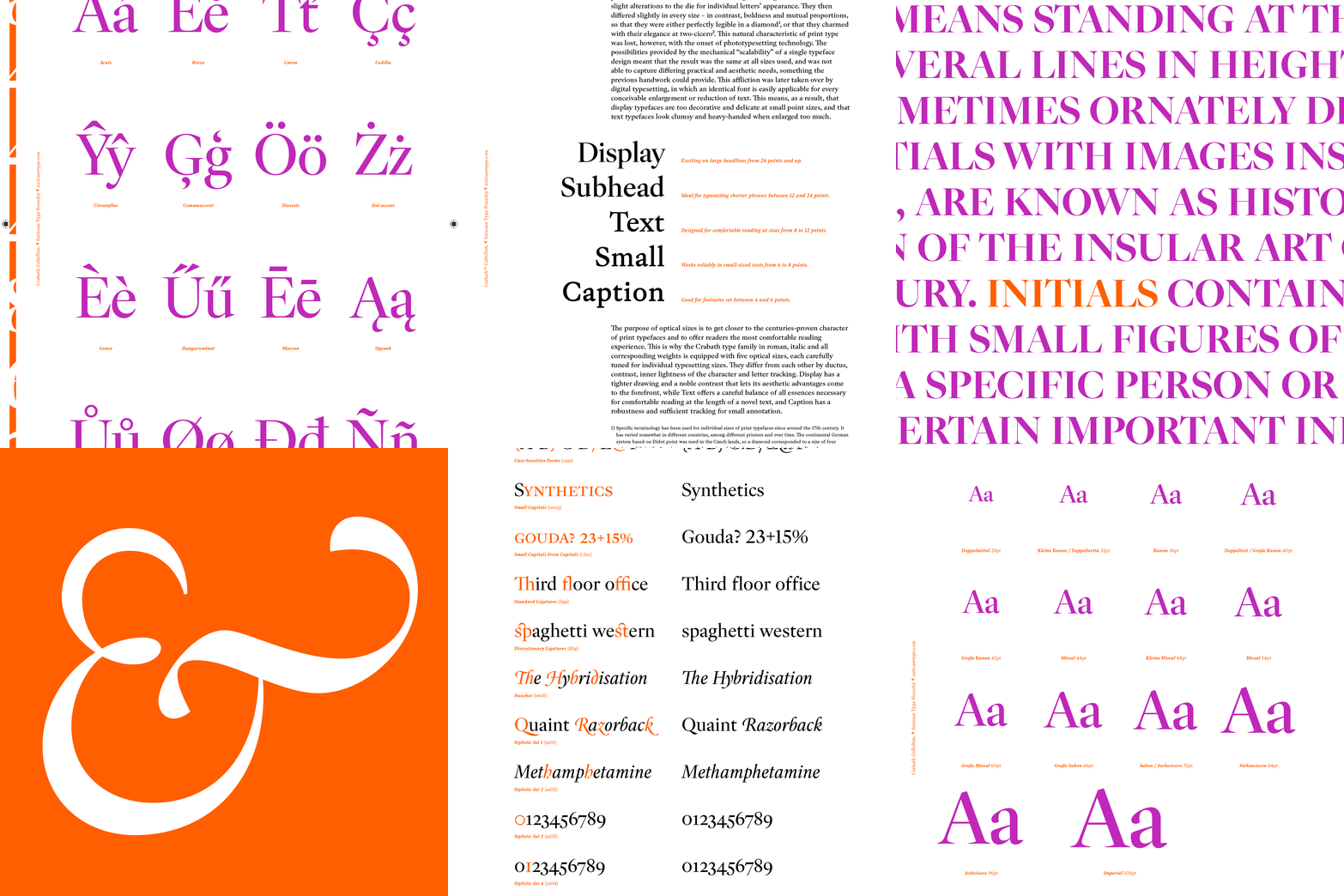
Crabath sensitively reproduces the variation in letterform design for individual sizes with a collection of five optical sizes ranging from Display to Text to Caption. Its distinctive decoration, typical for late Baroque typefaces, is deliberately muted here, so that its overall appearance suits the eye of the contemporary reader. At the same time, the stems of the italics are trimmed more evenly without losing the functional characteristics.
The sets are extensive enough in all weights to meet the needs of everyday digital typesetting. Each set includes small capitals, basic and decorative ligatures, and several figure variations. A pleasant x-height, adequate contrast, and sufficiently pronounced accents for all European languages means that this typeface is especially well-suited for long, complex and difficult-to-set texts, both in printed output and on screen. The delicate nature of the headline styles will likely awaken a desire for typographic compositions on book and magazine covers or on posters.

  • Number of fonts in a family: 72
  • Release date: 2021
  • Current version: 1.283
  • Available formats: OTF, TTF, WOFF, WOFF2
  • Design: Tomáš Brousil
117 languages
  • Afar
  • Afrikaans
  • Albanian
  • Aromanian
  • Aymara
  • Azeri (Latin)
  • Basque
  • Bemba
  • Bislama
  • Bosnian
  • Breton
  • Catalan
  • Chamorro
  • Cheyenne
  • Chichewa
  • Chuukese
  • Cofán
  • Cornish
  • Croatian
  • Czech
  • Danish
  • Dutch
  • English
  • Esperanto
  • Estonian
  • Faroese
  • Fijian
  • Finnish
  • French
  • Frisian
  • Friulian
  • Galician
  • Ganda
  • German
  • Gikuyu
  • Greenlandic
  • Guaraní
  • Gwich’in
  • Haitian
  • Hawaiian
  • Hungarian
  • Icelandic
  • Ido
  • Indonesian
  • Interlingua
  • Irish Gaelic
  • Italian
  • Javanese
  • Kashubian
  • Kinyarwanda
  • Kiribati
  • Kirundi
  • Kituba
  • Kurdish (Latin)
  • Ladin
  • Latvian
  • Lithuanian
  • Luxemburgish
  • Malagasy
  • Malay
  • Maltese
  • Manx
  • Māori
  • Marshallese
  • Montenegrin
  • Náhuatl
  • Nauruan
  • Navajo
  • Ndebele (Northern)
  • Ndebele (Southern)
  • Norfuk
  • Norn
  • Norwegian (Bokmål)
  • Occitan
  • Palauan
  • Papiamento
  • Pinyin
  • Polish
  • Portuguese
  • Quechua
  • Rhaeto-Romanic
  • Romaji
  • Romanian
  • Sámi (Inari)
  • Sámi (Lule)
  • Sámi (Northern)
  • Sámi (Southern)
  • Samoan
  • Sango
  • Sardinian
  • Scottish Gaelic
  • Seychelles Creole
  • Shona
  • Silesian
  • Slovak
  • Slovene
  • Somali (Latin)
  • Sotho
  • Spanish
  • Swahili
  • Swati
  • Swedish
  • Tagalog (Filipino)
  • Tahitian
  • Tetum
  • Tok Pisin
  • Tokelauan
  • Tongan
  • Tsonga
  • Tswana
  • Turkish
  • Tuvalu
  • Veps
  • Welsh
  • Wolof
  • Xhosa
  • Zulu

Styles

Display Extralight 
Display Extralight Italic 
Display Light 
Display Light Italic 
Display Book 
Display Book Italic 
Display Regular 
Display Italic 
Display Medium 
Display Medium Italic 
Display Semibold 
Display Semibold Italic 
Display Bold 
Display Bold Italic 
Display Extrabold 
Display Extrabold Italic
Subhead Light 
Subhead Light Italic 
Subhead Book 
Subhead Book Italic 
Subhead Regular 
Subhead Italic 
Subhead Medium 
Subhead Medium Italic 
Subhead Semibold 
Subhead Semibold Italic 
Subhead Bold 
Subhead Bold Italic
Text Light 
Text Light Italic 
Text Book 
Text Book Italic 
Text Regular 
Text Italic 
Text Medium 
Text Medium Italic 
Text Semibold 
Text Semibold Italic 
Text Bold 
Text Bold Italic
Small Light 
Small Light Italic 
Small Book 
Small Book Italic 
Small Regular 
Small Italic 
Small Medium 
Small Medium Italic 
Small Semibold 
Small Semibold Italic 
Small Bold 
Small Bold Italic
Caption Light 
Caption Light Italic 
Caption Book 
Caption Book Italic 
Caption Regular 
Caption Italic 
Caption Medium 
Caption Medium Italic 
Caption Semibold 
Caption Semibold Italic 
Caption Bold 
Caption Bold Italic
Initial A 
Initial B 
Initial C 
Initial D 
Initial E 
Initial F 
Initial G 
Initial H

Specimen

Crabath Display Extralight Italic

from 59 EUR

The

Crabath Display Extralight

from 59 EUR

Womanize

Crabath Display Extralight Italic

from 59 EUR

Interspatial

Crabath Display Light

from 59 EUR

Pathfinder

Crabath Display Light Italic

from 59 EUR

Neographic

Crabath Display Book

from 59 EUR

Brocatello

Crabath Display Book Italic

from 59 EUR

Synthetical

Crabath Display Regular

from 59 EUR

Giantkind

Crabath Display Italic

from 59 EUR

Zygosphere

Crabath Display Medium

from 59 EUR

Specimen

Crabath Display Medium Italic

from 59 EUR

Inviability

Crabath Display Semibold

from 59 EUR

Castellan

Crabath Display Semibold Italic

from 59 EUR

Astronaut

Crabath Display Bold

from 59 EUR

Lyonnais

Crabath Display Bold Italic

from 59 EUR

Redjacket

Crabath Display Extrabold

from 59 EUR

Smelling

Crabath Display Extrabold Italic

from 59 EUR

Quoddity

Crabath Subhead Medium

from 59 EUR

Encaustic painting, also called hot wax painting, is a technique that uses heated beeswax mixed with colored pigments.

Crabath Subhead Medium Italic

from 59 EUR

The molten mixture is applied to a surface, most commonly prepared wood, though canvas and other materials can also be used.

Crabath Text Regular

from 59 EUR

Watercolor is a painting method in which pigments are suspended in a water-soluble medium. The most common surface for watercolor is paper, although artists also use materials such as fabric, wood, canvas, vellum, or even plastics. In East Asia, watercolor techniques developed into traditions such as brush or scroll painting, often using monochrome ink.

Crabath Text Italic

from 59 EUR

Gouache is another water-based paint, but unlike watercolor, it is designed to be opaque. It contains a higher concentration of pigment, larger particles, and often includes a white filler such as chalk, which gives it a heavier, more solid appearance. Gouache produces a matte, reflective finish and is diluted with water like other water-based media. It has been widely used throughout history.

Crabath Small Regular

from 59 EUR

Enameling is a technique in which a surface—usually metal—is coated with powdered glass mixed with color-producing mineral oxides. The object is then fired at high temperatures, causing the glass to melt and fuse with the metal, creating a smooth, durable finish. Unlike most painted surfaces, enamel can be handled and exposed to moisture without damage. Historically, it was used to decorate precious objects, but it also served other purposes. A major center of this craft during the Renaissance was Limoges, where artists created detailed religious and mythological scenes on plaques and decorative items. In the 18th century, enamel painting became especially popular in Europe for portrait miniatures, and in the late 20th century it found new use as a durable medium for outdoor murals. Tempera, often called egg tempera, is a fast-drying and long-lasting painting medium made by mixing pigments with a water-soluble binder, most commonly egg yolk. It was one of the primary painting techniques before the widespread adoption of oil painting after 1500. Many early artworks created with tempera have survived for centuries, demonstrating its durability. The term “tempera” is sometimes also used for modern poster paints made with glue-based binders, although these differ from traditional egg tempera. Fresco refers to a group of mural painting techniques applied to plaster on walls or ceilings. The name comes from the Italian word affresco, meaning “fresh”.

Crabath Initial C

from 39 EUR

Kinetic

Crabath Small Italic

from 59 EUR

Acrylic paint is a fast-drying medium made from pigments suspended in an acrylic polymer emulsion. It can be diluted with water, but once it dries, it becomes water-resistant. Depending on how much it is thinned or modified with gels, pastes, or other media, acrylic paint can resemble watercolor or oil painting, or produce entirely unique visual effects. One of the main differences between acrylic and oil paint is drying time. Oil paint dries slowly, allowing more time for blending and layering techniques such as glazing. This can be beneficial for detailed work but may slow down the overall process. Acrylic paint, on the other hand, dries quickly, making it better suited for rapid work but less forgiving for extended blending. Unlike watercolor, which requires a porous surface such as paper, acrylic paint can be applied to a wide variety of surfaces. Both acrylic and watercolor paints can be cleaned with water, although acrylic should be washed off tools promptly, often with soap and water, to prevent it from hardening. Acrylic paint was developed in the mid-20th century. Between 1946 and 1949, Leonard Bocour and Sam Golden introduced an early version under the brand Magna, which used a solvent-based formula. Later, water-based acrylic paints became widely available, similar in composition to latex house paints. In 1963, George Rowney was the first to introduce artists’ acrylic paints in Europe under the name Cryla. Acrylic paints also became closely associated with experimental techniques such as grattage, a surrealist method that involves scraping or removing layers of paint. Acrylics are particularly suitable for this technique because they adhere well to surfaces while still allowing controlled removal or peeling.

Crabath Caption Regular

from 59 EUR

Acrylic paint is a fast-drying medium made from pigments suspended in an acrylic polymer emulsion. It can be diluted with water, but once it dries, it becomes water-resistant. Depending on how much it is thinned or modified with gels, pastes, or other media, acrylic paint can resemble watercolor or oil painting, or produce entirely unique visual effects. One of the main differences between acrylic and oil paint is drying time. Oil paint dries slowly, allowing more time for blending and layering techniques such as glazing. This can be beneficial for detailed work but may slow down the overall process. Acrylic paint, on the other hand, dries quickly, making it better suited for rapid work but less forgiving for extended blending. Unlike watercolor, which requires a porous surface such as paper, acrylic paint can be applied to a wide variety of surfaces. Both acrylic and watercolor paints can be cleaned with water, although acrylic should be washed off tools promptly, often with soap and water, to prevent it from hardening. Acrylic paint was developed in the mid-20th century. Between 1946 and 1949, Leonard Bocour and Sam Golden introduced an early version under the brand Magna, which used a solvent-based formula. Later, water-based acrylic paints became widely available, similar in composition to latex house paints. In 1963, George Rowney was the first to introduce artists’ acrylic paints in Europe under the name Cryla. Acrylic paints also became closely associated with experimental techniques such as grattage, a surrealist method that involves scraping or removing layers of paint. Acrylics are particularly suitable for this technique because they adhere well to surfaces while still allowing controlled removal or peeling. Aerosol paint, commonly known as spray paint, is a type of paint stored in a sealed, pressurized can and released as a fine mist when the valve is pressed. This method allows for quick and even coverage, producing a smooth surface. Standard spray cans are portable, affordable, and easy to store. Aerosol primers can also be applied directly to materials such as bare metal and certain plastics. Because of its speed, portability, and durability, spray paint became a popular medium for graffiti. In the late 1970s, graffiti evolved from simple signatures into more complex murals, with artists developing distinctive styles shaped by the properties of aerosol paint and the need to work quickly. Over time, graffiti and street art have come to be recognized as legitimate art forms, and specialized spray paints have been developed specifically for artists. Stencils are often used in spray painting to control the design. They block out areas of a surface, allowing paint to pass through only in selected shapes or patterns.

Crabath Caption Italic

from 59 EUR

Modernism refers to a broad set of cultural movements and ideas that emerged in response to major social, economic, and technological changes in Western society during the late 19th and early 20th centuries. It represented a break from traditional values, particularly those associated with realism. Artists, writers, and thinkers began to question established forms of expression, believing they no longer reflected the realities of an increasingly industrialized world. A key feature of modernism is self-awareness, often leading to experimentation with form and materials, and a tendency toward abstraction. Impressionism was one of the earliest movements associated with modernism in painting. It focused on capturing light and the fleeting nature of visual perception rather than precise detail. Artists often worked outdoors, painting directly from observation. Despite early criticism and rejection—particularly from the official Paris Salon—Impressionists gradually gained recognition by organizing their own exhibitions. A notable moment in this shift was the Salon des Refusés, established by Napoleon III to display works rejected by the traditional Salon. Abstract painting further advanced modernist ideas by removing direct references to the visible world. Instead, it relies on elements such as color, line, and form to create meaning. One important development within this direction was abstract expressionism, a post–World War II movement that combined emotional intensity with non-representational techniques. It drew influence from earlier European movements like Futurism, Bauhaus, and Cubism, while emphasizing individuality and experimentation. A key style within abstract expressionism is action painting, also known as gestural abstraction. In this approach, paint is applied spontaneously—dripped, splashed, or smeared onto the canvas—rather than carefully controlled. The physical act of painting becomes central to the artwork itself. This style was particularly prominent from the 1940s to the early 1960s and is closely associated with the broader movement of abstract expressionism. The term outsider art was introduced in 1972 by art critic Roger Cardinal as an English equivalent of art brut (“raw” or “rough” art). The concept of art brut was originally developed by French artist Jean Dubuffet to describe works created outside established cultural institutions, particularly those made by individuals in psychiatric institutions. Over time, outsider art has become a recognized category within the art market. For example, the Outsider Art Fair, held annually in New York since 1992, has contributed to its visibility and commercial success. However, the term is sometimes used too broadly, applied to any work produced outside the mainstream art world, regardless of the creator’s background or the nature of the work. Photorealism is a style of painting in which artists use photographs as the primary reference for their work.

OpenType features

The Hybridisation

Glyphs

Crabath in use